Capsule Machine
Solid Preparation
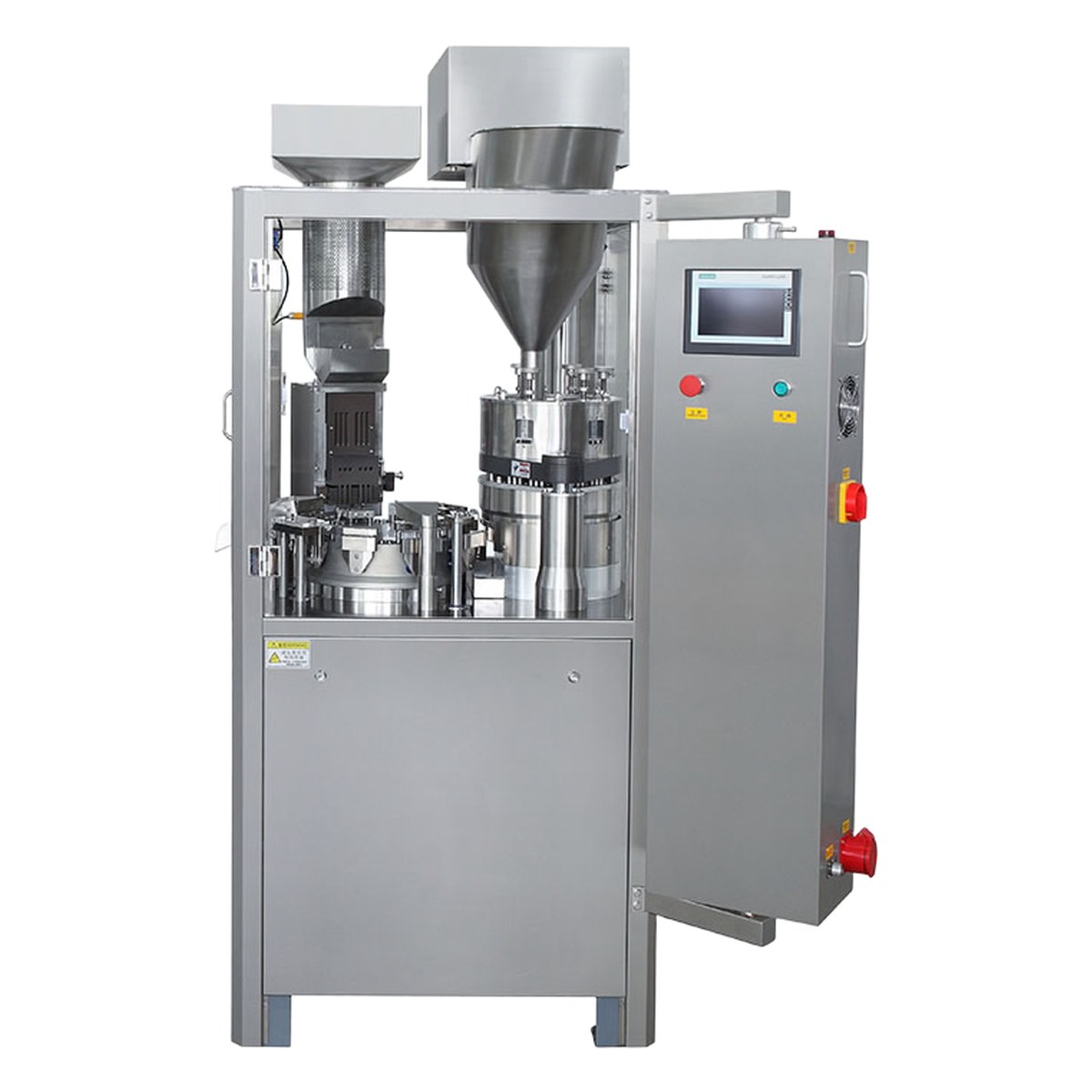
Capsule Filling Machine
1. Product Overview
1.1 General Description
A Capsule Filling Machine is a critical piece of pharmaceutical equipment designed to automatically fill powders, granules, and pellets into hard capsules with precise dosing. The machine performs a fully automated sequence of capsule feeding, separation, dosing, closing, and ejection, serving as an indispensable core unit in solid dosage manufacturing lines.
Modern capsule filling machines employ modular design principles, allowing flexible configuration to accommodate different product physical characteristics and production capacity requirements. The equipment complies with GMP regulations, with all product-contact components manufactured from high-grade stainless steel with polished surfaces for easy cleaning and maintenance. The machine operates smoothly with high dosing accuracy and high finished product yield, and is widely used in pharmaceutical, nutraceutical, herbal, and veterinary industries for hard capsule production.
1.2 Key Features
- High-precision dosing system with fill weight variation controlled within ±3%
- Fully automated operation: capsule feeding → separation → dosing → closing → ejection
- Modular design with quick-change format parts for different capsule sizes (000–5)
- GMP compliant; product-contact components made of SS 316L stainless steel
- PLC control system with touchscreen HMI for intuitive operation
- In-line check weighing for real-time fill weight monitoring
- Dust extraction system to effectively remove airborne powder and maintain clean operation environment
- Variable frequency speed control for stepless capacity adjustment within rated range
- Optional CIP (Clean-in-Place) capability to minimize changeover downtime
- Safety interlocked guard doors to protect operator safety
1.3 Document Scope
This technical specification document covers the design principles, performance parameters, system classification, core component selection, application fields, design standards and certifications, customizable options, warranty terms, packaging and delivery, and inquiry requirements for the Capsule Filling Machine product line. It serves as a comprehensive reference for procurement evaluation and technical communication.
2. Working Principle
2.1 Capsule Filling Process Flow
The complete working sequence of a capsule filling machine consists of the following continuous steps: capsule feeding → capsule separation (cap and body apart) → dosing and filling → capsule closing → finished product ejection. The entire process is driven by the main transmission mechanism, with precise positioning and coordinated operation at each station achieved through cam indexing mechanisms.
2.2 Capsule Feeding and Separation
Empty capsules are fed from the capsule hopper into the capsule guide channel, where they are sequentially transferred into the segment bores under vacuum suction. The upper and lower segments move in coordinated motion, and through the action of forks and guide rails, the capsule caps and bodies are automatically separated. The capsule bodies remain in the lower segment bores while the capsule caps stay in the upper segment bores, both maintaining alignment for subsequent filling.
2.3 Dosing and Filling
Dosing is the core process of the capsule filling machine, directly determining the accuracy and consistency of the fill weight. There are two primary dosing principles:
Tamping Dosing: The tamping pins compress powder from the dosing disc into plugs through multiple tamping actions (typically 5 strokes), then eject the formed plugs into the capsule bodies. Suitable for free-flowing powder materials, this method provides high filling accuracy and is the most commonly used dosing method.
Dosator Dosing: The dosator tube descends into the powder bed to capture a predetermined volume of powder, then transfers and ejects it into the capsule body using compressed air or a piston. Suitable for poorly flowing powders or materials containing granules and pellets, this method offers easier adjustment when changing products.
2.4 Capsule Closing and Ejection
After filling is completed, the upper and lower segments close together, and the closing pins push the capsule caps firmly onto the capsule bodies to achieve a tight lock. The closed capsules are ejected through the discharge port and conveyed to downstream inspection and packaging stations via a conveyor belt. Some models are equipped with in-line check weighing systems for real-time rejection of out-of-specification products.
3. System Classification
3.1 Classification by Number of Stations
| Stations | Typical Model | Max. Capacity | Application Scenario | Key Characteristics |
|---|---|---|---|---|
| 3 | NJP-3 | 6,000 caps/h | Lab / Pilot scale | Compact design, suitable for R&D and small batches |
| 6 | NJP-6 | 18,000 caps/h | Small-to-medium batch production | Best cost-performance ratio, most widely used |
| 8 | NJP-8 | 36,000 caps/h | Medium batch production | Multi-station high efficiency, suitable for regular formulations |
| 10 | NJP-10 | 60,000 caps/h | Large batch production | High capacity, suitable for scale-up production |
| 12 | NJP-12 | 180,000 caps/h | Ultra-large batch production | Maximum capacity, for continuous production |
3.2 Classification by Dosing Principle
| Dosing Method | Working Principle | Suitable Materials | Filling Accuracy | Advantages / Disadvantages |
|---|---|---|---|---|
| Tamping | Multiple tamping pins compress powder into plugs, then eject into capsule body | Free-flowing powders | ±2–3% | High accuracy, widely used; requires good powder flowability |
| Dosator | Dosator tube captures powder volume from powder bed, then ejects into capsule body | Poorly flowing powders, granules, pellets | ±3–5% | Good adaptability; slightly lower accuracy than tamping |
3.3 Classification by Application Field
| Application Field | Sub-categories | Special Requirements | Representative Products |
|---|---|---|---|
| Pharmaceutical | Antibiotics, anti-inflammatory, cardiovascular, GI drugs | GMP compliance, FDA 21 CFR Part 11, validation support | Amoxicillin, Omeprazole, Ibuprofen capsules |
| Nutriceutical | Vitamins, minerals, fish oil, probiotics | Food-grade materials, high capacity, quick changeover | Vitamin C, Fish oil, Probiotic capsules |
| Herbal Supplements | TCM powders, plant extracts, compound formulations | Cross-contamination prevention, enhanced dust extraction, easy clean | Isatis root, Ginkgo biloba, Panax notoginseng capsules |
| Veterinary | Veterinary antibiotics, anthelmintics, nutritional supplements | Large capsule sizes, high capacity, low-cost operation | Oxytetracycline, Ivermectin capsules |
4. Detailed Technical Parameters
4.1 Basic Technical Parameters
| Parameter | NJP-3 | NJP-6 | NJP-8 | NJP-10 | NJP-12 |
|---|---|---|---|---|---|
| Capacity (caps/h) | 6,000 | 18,000 | 36,000 | 60,000 | 180,000 |
| Capsule Size | 000–5 | 000–5 | 000–5 | 000–5 | 000–5 |
| Dosing Accuracy | ±3% | ±3% | ±3% | ±3% | ±3% |
| Number of Stations | 3 | 6 | 8 | 10 | 12 |
| Main Motor Power (kW) | 0.75 | 1.5 | 2.2 | 3.0 | 5.5 |
| Max. Fill Depth (mm) | 18 | 18 | 18 | 18 | 18 |
| Noise Level dB(A) | ≤70 | ≤72 | ≤75 | ≤75 | ≤78 |
| Compressed Air (MPa) | 0.4–0.6 | 0.4–0.6 | 0.4–0.6 | 0.4–0.6 | 0.4–0.6 |
| Vacuum (MPa) | -0.04~-0.08 | -0.04~-0.08 | -0.04~-0.08 | -0.04~-0.08 | -0.04~-0.08 |
| Yield Rate | ≥99.5% | ≥99.5% | ≥99.5% | ≥99.5% | ≥99.5% |
4.2 Tamping Type Parameters
| Parameter | NJP-6T | NJP-8T | NJP-10T | NJP-12T |
|---|---|---|---|---|
| Max. Capacity (caps/h) | 18,000 | 36,000 | 60,000 | 180,000 |
| Number of Tamping Pins | 5×6 | 5×8 | 5×10 | 5×12 |
| Tamping Strokes | 5 | 5 | 5 | 5 |
| Dosing Disc Diameter (mm) | 180 | 220 | 260 | 340 |
| Dosing Accuracy | ±2% | ±2% | ±2.5% | ±3% |
| Suitable Powder Type | Free-flowing powders | |||
| Max. Fill per Capsule (mg) | 750 | 750 | 750 | 750 |
| Dosing Disc Material | SS 316L / Food-grade nylon |
4.3 Dosator Type Parameters
| Parameter | NJP-6D | NJP-8D | NJP-10D |
|---|---|---|---|
| Max. Capacity (caps/h) | 15,000 | 30,000 | 50,000 |
| Number of Dosator Tubes | 6 | 8 | 10 |
| Dosator Tube Diameter (mm) | 3–16 | 3–16 | 3–16 |
| Dosing Accuracy | ±3% | ±3.5% | ±4% |
| Suitable Materials | Powders / Granules / Pellets | ||
| Max. Fill per Capsule (mg) | 800 | 800 | 800 |
| Dosator Tube Material | SS 316L + PTFE coating | ||
| Powder Bed Height Adjustment | Auto / Manual |
4.4 Dimensions and Weight
| Model | Length (mm) | Width (mm) | Height (mm) | Net Weight (kg) | Floor Space (m²) |
|---|---|---|---|---|---|
| NJP-3 | 800 | 700 | 1550 | 350 | 0.7 |
| NJP-6 | 900 | 800 | 1650 | 600 | 1.0 |
| NJP-8 | 1000 | 900 | 1700 | 900 | 1.3 |
| NJP-10 | 1200 | 1000 | 1800 | 1300 | 1.8 |
| NJP-12 | 1500 | 1200 | 1950 | 2200 | 2.6 |
4.5 Powder Properties
| Powder Property | Requirement | Notes |
|---|---|---|
| Bulk Density | 0.2–1.2 g/mL | Outside range requires special dosing design |
| Moisture Content | ≤5% | Higher moisture may cause sticking |
| Particle Size Distribution | 10–500 μm | Pellets up to 3 mm |
| Angle of Repose | ≤35° | Larger angle indicates poor flowability |
| Powder Temperature | 15–30°C | Higher temperature may cause caking |
| Powder Corrosiveness | None / Mild | Strongly corrosive requires special materials |
5. Core Component Selection
5.1 Dosing System
The dosing system is the core of the capsule filling machine, directly determining filling accuracy and product consistency. Based on the dosing principle, it is categorized into tamping and dosator types. Selection should consider material characteristics, capacity requirements, dosing accuracy, and changeover frequency.
- Tamping dosing system: 5-stroke powder compaction into plugs, suitable for free-flowing powders, accuracy ±2-3%
- Dosator dosing system: volumetric dosing method, suitable for poorly flowing or granule/pellet-containing materials, accuracy ±3-5%
- Dosing disc/tube material options: SS 316L stainless steel, food-grade nylon, PTFE coating
- In-line weight feedback: Dynamic check weigher for real-time fill weight adjustment and consistency assurance
5.2 Capsule Handling Mechanism
The capsule handling mechanism is responsible for the orderly feeding and separation of empty capsules, including capsule hopper, guide channels, vacuum separation device, and upper/lower segments. Precise positioning is a prerequisite for subsequent filling quality.
- Capsule hopper: Stainless steel, 1–3 L capacity, with sight glass for level observation
- Vacuum separation device: Precise vacuum control for reliable cap-body separation
- Upper/lower segments: Precision-machined bores ensuring coaxiality, quick-change segments
- Capsule sorter: Prevents reverse or double-feeding, rejected capsule rate ≤0.3%
5.3 Closing Mechanism
The closing mechanism closes the capsule caps and bodies through coordinated segment movement and closing pin action. Precise control of closing force is critical to prevent capsule damage and ensure locking quality.
- Adjustable closing force: Set according to capsule size and material characteristics to prevent over/under-locking
- Closing detection: Photoelectric sensor verifies locking status, automatic rejection of unlocked capsules
- Closing pin material: SS 316L, polished surface Ra ≤ 0.4 μm
5.4 Powder Feeding System
The powder feeding system ensures a constant powder bed height in the dosing chamber, which is key to dosing consistency. The system typically includes a powder hopper, agitator, and automatic feeding device.
- Powder hopper: SS 316L, 5–20 L capacity, agitator to prevent bridging
- Auto-feeding: Level sensor monitors powder level, automatically controls feed valve
- Agitator: Variable frequency speed control, adapts to different material characteristics, ensures uniform bed density
5.5 Control System
Modern capsule filling machines are equipped with advanced PLC control systems for precise, repeatable, and validated operation. The control system architecture includes:
- PLC: Industrial programmable logic controller (Siemens S7 / Mitsubishi) for sequence control and safety interlocks
- HMI: 7" or 10" color touchscreen, real-time display of operating parameters and alarm information
- Recipe management: Up to 100 configurable recipes with password protection for quick product changeover
- Data logging: Electronic batch records compliant with FDA 21 CFR Part 11
- Alarm system: Multi-level protection (powder shortage, capsule jam, air pressure, motor overload, etc.)
- Communication: Ethernet/IP, Modbus TCP, or OPC UA for SCADA/MES integration
6. Typical Application Fields
6.1 Pharmaceutical Capsules
The pharmaceutical industry is the primary application sector for capsule filling machines, with the most stringent requirements for compliance, accuracy, and reliability.
- Antibiotics: Amoxicillin, Cephalexin, Azithromycin — high capacity, low cross-contamination risk
- GI drugs: Omeprazole, Pantoprazole, Lansoprazole — moisture-sensitive, require moisture-proof design
- Cardiovascular: Aspirin, Clopidogrel, Rosuvastatin — extremely high dosing accuracy required
- Analgesics: Ibuprofen, Paracetamol — high volume, cost-sensitive
6.2 Nutraceuticals
The nutraceutical industry is characterized by a wide variety of products, frequent changeovers, and high capacity requirements.
- Vitamin-mineral complex capsules — multi-component mixed filling, anti-segregation required
- Fish oil / Omega-3 capsules — liquid filling or powder-encapsulated filling
- Probiotic capsules — sensitive to temperature and humidity, require rapid sealing
6.3 Herbal Supplements
Herbal and plant extract capsule filling has special requirements for cross-contamination prevention and dust extraction.
- TCM powder capsules — powders typically have poor flowability, enhanced dust extraction needed
- Plant extract capsules — highly hygroscopic, moisture protection required
6.4 Veterinary Medicine
Veterinary capsule filling typically uses large capsule sizes, with high requirements for capacity and low-cost operation.
- Veterinary antibiotic capsules — large sizes (Size 0-000), high capacity priority
- Veterinary anthelmintics — often contain granules or pellets, suitable for dosator filling
7. Design Standards and Certifications
7.1 GMP Compliance
All product-contact components are designed and manufactured in compliance with current GMP guidelines. Equipment design facilitates easy cleaning, eliminates dead legs (>1.5D compliance), and provides full traceability of materials and manufacturing processes. Product-contact surface finish Ra ≤ 0.4 μm.
7.2 FDA Compliance
The control system complies with FDA 21 CFR Part 11 requirements for electronic records and electronic signatures, including: audit trail, user authentication with role-based access control, electronic batch records, data integrity verification, and compliant data export.
7.3 ISO 9001
Manufacturing facilities are ISO 9001:2015 certified, ensuring consistent quality management across design, procurement, production, testing, and after-sales service.
7.4 CE Marking
Equipment meets the essential health and safety requirements of the EU Machinery Directive (2006/42/EC) and Low Voltage Directive (2014/35/EU). CE marking is applied to all models destined for the European market.
7.5 Certification Summary
| Standard / Certification | Scope | Compliance Level | Certificate / Report |
|---|---|---|---|
| GMP (cGMP) | Design, manufacturing, documentation | Full compliance | GMP compliance certificate |
| FDA 21 CFR Part 11 | Electronic records, audit trail, access control | Full compliance | Validation documentation package |
| ISO 9001:2015 | Quality management system | Certified | ISO 9001 certificate |
| CE Marking | Machinery, low voltage directives | Compliant | Declaration of Conformity |
| Chinese Pharmacopoeia (ChP) | Equipment applicability, material compatibility | Compliant | Material test reports |
8. Customizable Options
The capsule filling machine product line offers extensive customization to meet specific process requirements, regulatory environments, and facility constraints. The following table summarizes available options:
| No. | Customization Item | Available Options | Default Configuration | Impact on Lead Time |
|---|---|---|---|---|
| 1 | Dosing Method | Tamping / Dosator / Dual-mode | Tamping | +2–3 weeks for dual-mode |
| 2 | Capsule Size | Single size / Multi-size kit (000–5 selectable) | Size 0 (default) | +1–2 weeks for multi-size kit |
| 3 | Control System | Standard PLC+HMI / Siemens S7 / Full SCADA integration | Standard PLC + 7" HMI | +3–4 weeks for SCADA |
| 4 | In-line Check Weighing | None / Static check weigher / Dynamic check weigher + feedback control | None | +2–3 weeks for dynamic |
| 5 | CIP Capability | Manual clean / CIP capable | Manual clean | +2–3 weeks for CIP |
| 6 | Dust Extraction | Standard / Industrial vacuum integrated / Isolator integrated | Standard | +4–6 weeks for isolator |
| 7 | Explosion-proof Rating | Standard / ATEX Zone 1 / ATEX Zone 2 | Standard | +3–4 weeks for Ex-proof |
| 8 | Material Certification | Standard mill cert / EN 10204 3.1 / 3.2 / FDA material compliance letter | Standard mill cert (3.1) | +1 week for 3.2 |
| 9 | Safety Guards | Standard guard doors / Light curtains / Full enclosure | Standard guard doors | +2 weeks for full enclosure |
| 10 | Documentation Package | Standard (manual + drawings) / GMP documentation / Full validation (IQ/OQ/PQ) | Standard | +4–8 weeks for full validation |
9. Warranty Terms
9.1 Standard Warranty
The manufacturer provides a standard warranty covering defects in material and workmanship under normal use and proper maintenance. The warranty periods are as follows:
| Warranty Category | Duration | Coverage Scope | Conditions |
|---|---|---|---|
| Main Equipment Warranty | 12 months | All components including transmission, dosing, control system, and frame | 12 months from commissioning or 14 months from shipment, whichever comes first |
| Extended Warranty (optional) | 24 months | Same as standard warranty with extended duration | Must be purchased at time of order; additional cost applies |
| Consumable Parts Warranty | 6 months | Seals, tamping pins, segments, O-rings, and other consumable parts | From date of shipment; normal wear excluded |
9.2 Warranty Exclusions
- Damage caused by misuse, negligence, improper installation, or operation outside specified parameters
- Normal wear and tear of consumable components (seals, pins, segments)
- Damage caused by processing products not compatible with the equipment materials
- Unauthorized modifications, repairs, or use of non-original spare parts
- Damage caused by inadequate maintenance or failure to follow prescribed maintenance schedules
- Consequential or incidental damages, including production losses and product damage
9.3 Warranty Service
- Remote technical support available within 4 hours of notification during business hours
- On-site service response within 48 hours (domestic), 5 business days (international)
- Free replacement of defective parts during warranty period (shipping costs included for domestic)
- Software updates provided free of charge during warranty period
10. Packaging and Delivery
10.1 Packaging
All capsule filling machines are packaged in compliance with international shipping standards. Packaging specifications are as follows:
- Export-grade wooden crate (ISPM 15 compliant, heat-treated, stamped)
- Equipment secured with heavy-duty strapping and foam cushioning
- Moisture barrier: VCI film wrap for corrosion protection during transit and storage
- Desiccant packs placed inside the crate for humidity control
- All openings sealed with protective caps to prevent contamination
- Lifting points clearly marked for crane/forklift handling
- Documentation pouch attached to exterior containing packing list, certificate of origin, and inspection reports
10.2 Shipping and Delivery
| Item | Details |
|---|---|
| Standard Lead Time | 8–12 weeks from order confirmation (standard configuration) |
| Custom Configuration Lead Time | 12–20 weeks depending on customization scope |
| Incoterms | FOB Shanghai / CIF / DAP (as agreed) |
| Shipping Method | Sea freight (standard), air freight (urgent, additional cost) |
| Shipping Marks | Per customer specification; default includes model, PO number, destination |
| Insurance | All-risk marine cargo insurance included for CIF terms; optional for FOB |
| Installation Support | Optional on-site installation and commissioning service (separate quotation) |
10.3 Storage Requirements
- Store in a dry, covered area with ambient temperature 5–40°C and relative humidity < 75%
- Do not stack crates; keep original packaging until installation
- Inspect VCI wrap integrity every 3 months for long-term storage (> 6 months)
- Rotate main shaft manually every 2 months during extended storage to prevent seal deformation
11. Information Required for Inquiry
To provide an accurate and comprehensive quotation, please supply the following information when submitting an inquiry. Incomplete information may result in delays or assumptions that may not match your requirements.
| No. | Required Information | Description / Example |
|---|---|---|
| 1 | Material Type and Characteristics | Powder / Granules / Pellets; bulk density, moisture content, particle size distribution, angle of repose |
| 2 | Capsule Size | Size 000/00/0/1/2/3/4/5; Gelatin / HPMC / Pullulan |
| 3 | Target Production Capacity | Caps/h or batch output (e.g., 30,000 caps/h) |
| 4 | Fill Weight | Target fill weight per capsule and acceptable tolerance (e.g., 250 mg ±3%) |
| 5 | Regulatory and Certification Requirements | GMP, FDA, CE, Chinese Pharmacopoeia, etc. |
| 6 | Special Environmental Conditions | Explosion-proof, cleanroom class, temperature/humidity control requirements |
| 7 | Automation Integration Requirements | Upstream/downstream equipment interface, SCADA/MES integration, electronic batch records |
| 8 | Delivery and Installation Conditions | Delivery location, installation space limitations, available power and compressed air supply |