Eye Drop Filler
Liquid Preparation
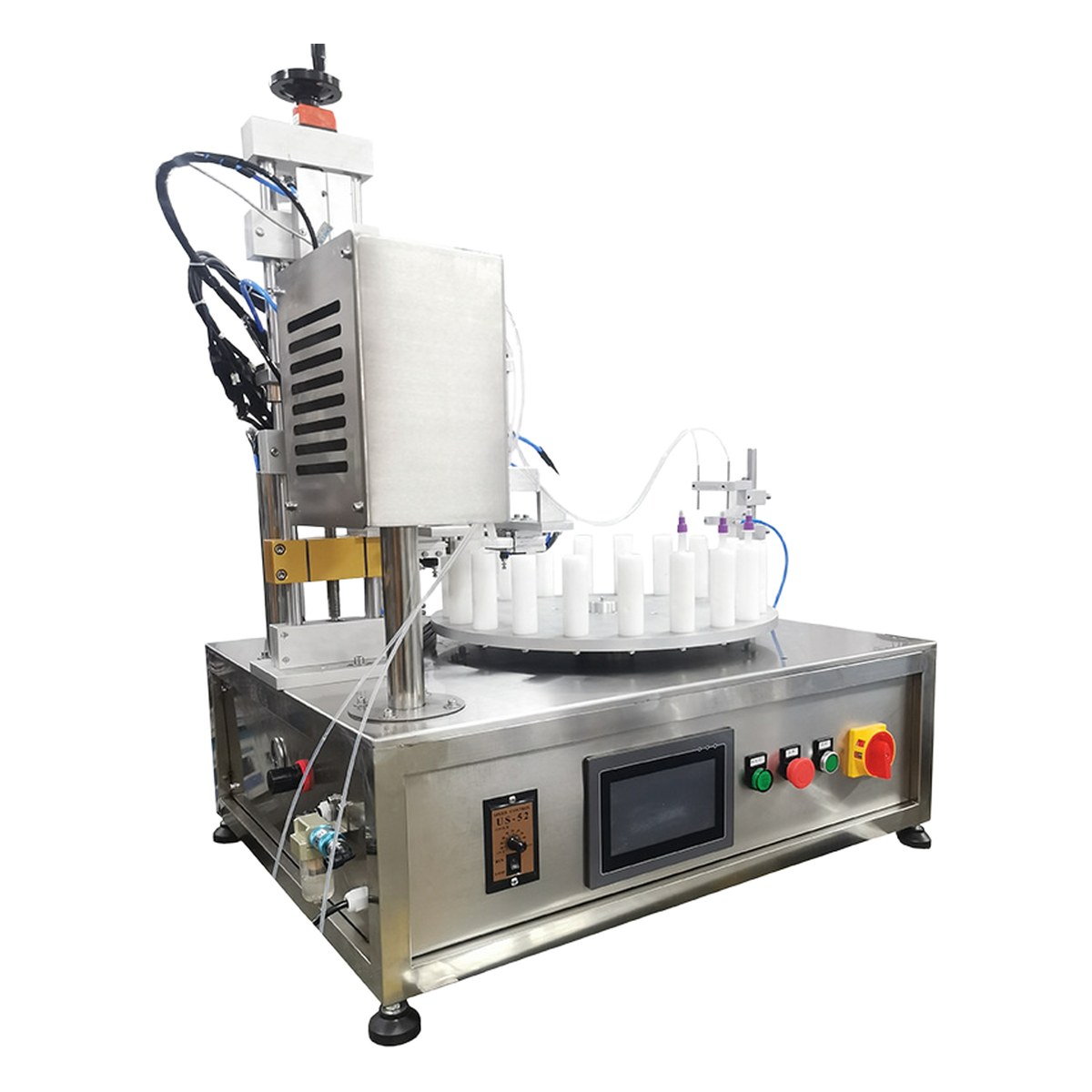
Eye Drop Filling Machine
Technical Specification Document
EQP-PHL-004
1. Product Overview
The eye drop filling machine is a high-precision aseptic filling equipment specifically designed for the ophthalmic pharmaceutical industry, used for metered filling of eye drops (ophthalmic solutions) into various eye drop bottles. The equipment operates under Class 100 laminar flow conditions, ensuring the product remains in a sterile state throughout the filling process, meeting the stringent requirements of GMP and FDA for ophthalmic preparation manufacturing.
Bottle unscrambling, filling, stoppering (inner plug), capping (outer cap) and discharge are integrated in a single unit. A fully enclosed design equipped with Clean-in-Place (CIP) and Sterilize-in-Place (SIP) systems effectively prevents cross-contamination and safeguards product quality. The core filling accuracy can reach ±1%, suitable for 1-30ml eye drop bottles of various specifications.
The machine is widely used on eye drop production lines at pharmaceutical companies and is an essential piece of equipment for ophthalmic preparation manufacturing. The equipment design complies with the Chinese Pharmacopoeia ophthalmic preparation monograph requirements and has obtained CE certification and ISO 13485 medical device quality management system certification.
2. Working Principle
Eye drop filling machines are classified into rotary and linear types based on structural configuration. Rotary filling machines employ continuous rotation operation with stations distributed along the circumference. Bottles are driven by the turntable through unscrambling, filling, stoppering, and capping stations sequentially, offering high production efficiency for large-volume production. Linear filling machines operate with stepwise intermittent motion, advancing bottles through each station on a conveyor belt — well suited to small-batch, multi-product manufacturing with quick format changes.
Three metering methods are available: (1) Peristaltic pump metering — liquid is delivered by peristaltic rollers compressing silicone tubing, with no risk of cross-contamination; changing the tubing allows quick product changeover, ideal for multi-product operation; (2) Ceramic pump metering — alumina ceramic plunger pumps deliver extremely high precision (±0.5%) with excellent wear and corrosion resistance for long-term, high-volume production; (3) Piston pump metering — stainless steel piston pumps offer a simple, cost-effective design for low-viscosity liquids.
Filling is performed sub-surface (immersion filling): the filling needle sits below the liquid level inside the bottle, effectively preventing splashing and bubble formation. The stoppering mechanism uses vacuum suction to pick inner plugs, with a robotic arm precisely pressing them into the bottle opening. The capping mechanism uses a torque-adjustable capping head to ensure consistent tightening torque. The entire production process operates under ISO Class 5 (Class 100) laminar flow hood protection, ensuring a sterile environment.
3. System Classification
By production capacity: (1) Small-scale — capacity ≤3,000 bph, suitable for R&D laboratories and small-scale pilot production, compact footprint, flexible operation; (2) Medium-scale — capacity 3,000-8,000 bph, suitable for medium-sized pharmaceutical enterprises for routine production, high cost-effectiveness, the mainstream choice on the market; (3) Large-scale — capacity ≥8,000 bph, suitable for large pharmaceutical enterprises for mass production, equipped with multiple filling heads and automated loading/unloading systems.
By filling pump type: (1) Peristaltic pump type — no cross-contamination, convenient tubing replacement, suitable for multi-variety shared-line production, but silicone tubing has limited service life; (2) Ceramic pump type — highest precision, long service life, suitable for long-term large-batch single-product production, higher cost; (3) Piston pump type — simple and reliable structure, low cost, suitable for low-viscosity liquids, slightly lower precision than ceramic pumps.
By automation level: (1) Semi-automatic — manual bottle loading, automatic filling, stoppering, and capping, suitable for small-scale production; (2) Fully automatic — automatic bottle unscrambling, filling, stoppering, capping, and discharge, equipped with touch screen and PLC control system, suitable for scale production; (3) Integrated line — linked with bottle washer, sterilization tunnel, labeling machine, and other equipment to achieve complete line automation.
4. Detailed Technical Parameters
The following tables present the detailed technical parameters of the eye drop filling machine, categorized by different classifications.
Table 4-1 Basic Technical Parameters
| Parameter | Specification |
|---|---|
| Production Capacity | 1,000-12,000 bph (depending on model) |
| Filling Volume | 1-30ml |
| Filling Accuracy | ±1% (ceramic pump ±0.5%) |
| Applicable Bottle Size | 5-30ml eye drop bottles |
| Number of Filling Heads | 2-16 heads (depending on model) |
| Capping Torque | 5-30N·m adjustable |
| Power Supply | 380V/50Hz (3-phase) or customized |
| Total Power | 3-12kW (depending on model) |
| Compressed Air | 0.4-0.6MPa, consumption 0.3-1.0m³/min |
| Noise Level | ≤65dB(A) |
| Cleanroom Class | ISO Class 5 (Class 100) laminar flow |
Table 4-2 Rotary Filling Machine Parameters
| Parameter | Specification |
|---|---|
| Capacity Range | 3,000-12,000 bph |
| Number of Filling Heads | 4-16 heads |
| Turntable Stations | 8-24 stations |
| Applicable Bottle Diameter | φ15-φ40mm |
| Applicable Bottle Height | 30-120mm |
| Changeover Time | 15-30 minutes |
| Machine Weight | 800-2,500kg |
Table 4-3 Linear Filling Machine Parameters
| Parameter | Specification |
|---|---|
| Capacity Range | 1,000-6,000 bph |
| Number of Filling Heads | 2-8 heads |
| Number of Stations | 4-12 stations |
| Applicable Bottle Diameter | φ12-φ45mm |
| Applicable Bottle Height | 25-130mm |
| Changeover Time | 10-20 minutes |
| Machine Weight | 500-1,500kg |
Table 4-4 Dimensional Parameters
| Model | Length (mm) | Width (mm) | Height (mm) |
|---|---|---|---|
| Small-scale | 1,800-2,500 | 800-1,200 | 1,600-2,000 |
| Medium-scale | 2,500-4,000 | 1,200-1,800 | 1,800-2,200 |
| Large-scale | 4,000-6,000 | 1,800-2,500 | 2,000-2,500 |
Table 4-5 Material Specifications
| Component | Material | Surface Treatment |
|---|---|---|
| Frame | 304 Stainless Steel | Brushed polish Ra≤0.8μm |
| Product Contact Parts | 316L Stainless Steel | Mirror polish Ra≤0.4μm |
| Filling Pump (Ceramic) | 99.7% Alumina Ceramic | Precision grinding |
| Filling Pipeline | 316L SS / PTFE | Mirror polish Ra≤0.4μm |
| Seals | PTFE / Silicone (USP Class VI) | N/A |
| Laminar Flow Hood | 304 Stainless Steel | Brushed polish Ra≤0.8μm |
| Conveyor Belt | 316L Stainless Steel | Mirror polish Ra≤0.4μm |
| Viewing Window | Tempered Glass | N/A |
5. Core Component Selection
Filling pump system: Peristaltic pumps use high-precision stepper motor drive with speed stability ≤0.1%; silicone tubing complies with USP Class VI standards with service life ≥2,000 hours. Ceramic pumps use 99.7% alumina ceramic material with piston clearance ≤2μm, metering accuracy ±0.5%, and service life ≥5 years. Piston pumps use 316L stainless steel with PTFE seals, metering accuracy ±1%.
Bottle handling system: Stainless steel turntable or conveyor chain equipped with photoelectric sensors for bottle position detection, bottle positioning accuracy ≤0.5mm. Unscrambling methods include vibratory bowl or rotary unscrambler, accommodating round, square, and other bottle types. Conveyor speed is variable frequency adjustable for smooth transport without bottle tipping.
Stoppering and capping unit: The stoppering mechanism uses vacuum plug suction with plug pickup rate ≥99.9% and adjustable plug pressing force. The capping mechanism uses servo motor drive with adjustable tightening torque of 5-30N·m and torque accuracy ±5%. Equipped with sensors for detecting missing or misaligned caps, with automatic rejection of non-conforming products.
Sterile environment system: Laminar flow hood uses ISO Class 5 (Class 100) HEPA filters with filtration efficiency ≥99.99% (0.3μm) and adjustable air velocity of 0.3-0.5m/s. The hood is constructed of 304 stainless steel with rounded interior corners for easy cleaning and disinfection. Differential pressure sensors monitor the pressure difference between inside and outside the hood, with automatic alarms for out-of-specification conditions.
Control system: Industrial-grade PLC (Siemens/Mitsubishi) + touch screen (10 inches or larger) control solution. Features recipe management function capable of storing ≥50 sets of production parameters. Features electronic batch record function recording filling volume, torque, differential pressure, and other key parameters. Supports OPC UA communication protocol for MES/SCADA system integration.
6. Typical Application Fields
Ophthalmic solutions: Aseptic filling of various eye drops (antibiotics, corticosteroids, anti-glaucoma, artificial tears, etc.). Eye drops represent the most typical application field, and the equipment design fully meets the aseptic production and precision requirements for ophthalmic preparations.
Nasal sprays: Aseptic filling of nasal spray solutions with similar bottle types and filling volumes to eye drops; the equipment can be adapted with simple adjustments. Nasal sprays have equally stringent sterility requirements, and this equipment's Class 100 laminar flow environment fully meets their production needs.
Ear drops: Aseptic filling of otic drops with typical filling volumes of 5-10ml and bottle types similar to eye drop bottles. Ear drops have the same requirements for filling accuracy and sterility as eye drops.
Small-volume sterile liquids: Aseptic filling of other small-volume (1-30ml) sterile liquids such as topical solutions, irrigation solutions, etc. The equipment's versatility and high precision make it widely applicable to various small-volume sterile preparation manufacturing.
7. Design Standards and Certification
GMP Compliance: Equipment design fully complies with China GMP (2010 Revision) and EU GMP Annex 1 requirements for sterile preparation manufacturing equipment. Equipment surfaces are smooth and free of dead corners for easy cleaning and disinfection; product-contact components use 316L stainless steel or ceramic materials that do not shed or permeate.
FDA Compliance: Equipment design meets FDA 21 CFR Part 211 (Current GMP for Finished Pharmaceuticals) requirements. The control system complies with 21 CFR Part 11 electronic records and electronic signature requirements, featuring audit trail functionality.
ISO 13485: Equipment manufacturing and quality management system is certified to ISO 13485 medical device quality management system, ensuring full-process quality control from design to delivery.
CE Certification: Equipment has passed CE certification, complying with EU Machinery Directive 2006/42/EC and Electromagnetic Compatibility Directive 2014/30/EU requirements.
Chinese Pharmacopoeia: Equipment design complies with the Chinese Pharmacopoeia ophthalmic preparation monograph (General Chapter 0105) requirements, ensuring that post-filling product sterility testing, fill volume variation, and other indicators meet specified requirements.
8. Customizable Options
The following is the list of customizable options for the eye drop filling machine. Customers may select options based on actual production requirements.
Table 8-1 Optional Configuration List
| No. | Configuration | Description | Application |
|---|---|---|---|
| 1 | In-line Check Weighing | 100% in-line weight verification of fill volume | High-precision filling requirements |
| 2 | Vision Inspection System | Bottle appearance, liquid level, defect detection | Comprehensive quality control |
| 3 | Automatic Bottle Loader | Automatic bottle sorting and loading | Fully automated production lines |
| 4 | CIP/SIP System | Clean-in-Place & Sterilize-in-Place | Multi-product shared line production |
| 5 | Nitrogen Purge Filling | Nitrogen protection to prevent oxidation | Oxidation-sensitive products |
| 6 | Temperature-Controlled Filling | Filling temperature controllable 20-40°C | Temperature-sensitive products |
| 7 | Multi-Format Quick Change Kit | Rapid changeover of bottle molds and pipelines | Multi-variety small-batch production |
| 8 | MES System Integration | Data interconnection with MES system | Smart manufacturing / digital workshop |
| 9 | Remote Maintenance Module | Remote monitoring and fault diagnosis | Multi-national / remote equipment mgmt |
| 10 | Isolator Integration | Seamless integration with isolator system | Highly toxic / highly active products |
9. Warranty Terms
Equipment warranty period: 12 months for the complete machine (from acceptance date), 24 months for core components (filling pumps, servo motors, PLC), and 6 months for consumable parts (seals, silicone tubing, filters).
Warranty scope: During the warranty period, the supplier provides free repair and replacement of parts for failures caused by the equipment's own quality issues. Damage caused by improper operation, improper maintenance, or force majeure is not covered under warranty.
After-sales response: Telephone response within 2 hours of receiving customer fault notification, solution proposed within 24 hours; if on-site service is required, engineers will arrive within 48 hours (domestic customers).
Training services: 3-5 days of on-site operation and maintenance training provided upon equipment delivery, covering equipment operation, routine maintenance, and simple troubleshooting. Certificates of operation are issued upon successful completion of training assessment.
Lifetime technical support: After the warranty period, the supplier provides lifetime paid technical support and spare parts supply services to ensure long-term stable operation of the equipment.
10. Packaging and Delivery
Packaging method: Equipment is packaged in wooden crates with internal shockproof and moisture-proof treatment. Crates are made of export-standard non-fumigation plywood with internal EPE foam and moisture barrier film protection. Packaging meets export shipping standards ensuring safe long-distance transportation.
Delivery lead time: Standard models 60-75 working days, customized models 90-120 working days, calculated from the date of contract signing and receipt of advance payment.
Transportation method: Domestic customers by truck transport, international customers by sea freight (CIF/FOB), air freight available for special requirements. Transport insurance is purchased by the supplier covering full-journey transportation risks.
Installation and commissioning: After equipment arrives at the customer site, the supplier dispatches engineers within 5 working days for installation and commissioning. Installation and commissioning period is 5-10 working days, followed by FAT/SAT acceptance.
Accompanying documentation: Equipment operation manual (Chinese/English), electrical schematic diagrams, pneumatic schematic diagrams, consumable parts list, certificate of conformity, and CE certificate copy.
11. Information Required for Inquiry
To provide accurate equipment pricing and technical proposals, please provide the following information when inquiring:
Table 11-1 Information Required for Inquiry
| No. | Information Item | Description |
|---|---|---|
| 1 | Product Information | Product name, viscosity, density, particulate content |
| 2 | Filling Specifications | Fill volume (ml), bottle type dimensional drawing |
| 3 | Capacity Requirements | Target output (bph or bottles per shift) |
| 4 | Cleanroom Class | Production area cleanroom classification requirements |
| 5 | Utilities | Power supply specs, compressed air, PW/WFI connections |
| 6 | Material Requirements | Special material requirements for product-contact parts |
| 7 | Certification Requirements | GMP/FDA/CE or other certification requirements |
| 8 | Other Special Requirements | Explosion-proof, anti-static, special environment, etc. |