CIP System
Liquid Preparation
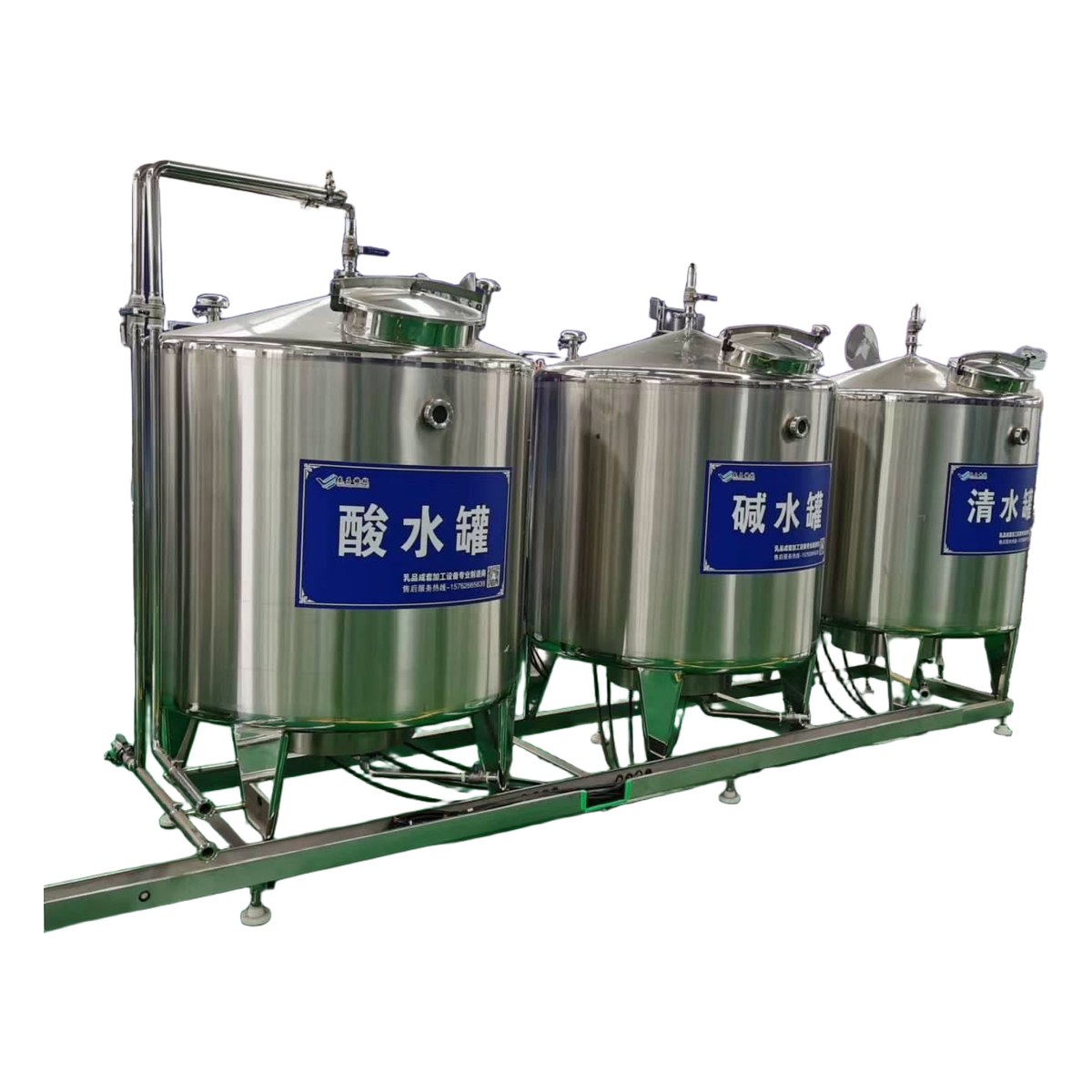
CIP Cleaning System
1. Product Overview
The CIP (Clean-In-Place) Cleaning System is automated cleaning equipment that delivers comprehensive, efficient cleaning and disinfection of the interiors of pipelines, storage tanks, reactors, heat exchangers and other process equipment without disassembly.
This system is widely used in the pharmaceutical, food, biotechnology, and cosmetics industries, and is one of the key systems for achieving GMP-compliant production. By programming the key parameters of each cycle — flow rate, temperature, solution concentration and duration — the CIP system delivers consistent, repeatable cleaning results, reduces cross-contamination risk, raises production efficiency and cuts manual handling and downtime.
This specification document provides a detailed description of the technical parameters, core component selection, typical application fields, design standards and certifications of the CIP cleaning system, serving as a comprehensive technical reference for equipment selection and procurement.
2. Working Principle
The CIP cleaning system employs a multi-step circulation cleaning process. The typical cleaning sequence includes the following stages:
① Pre-rinse: The equipment interior is flushed first with purified or potable water to remove product residues and coarse particulates ahead of the subsequent steps. The pre-rinse typically lasts 5-15 minutes, at a flow velocity high enough to maintain turbulent flow along the pipe wall.
② Caustic Wash: Circulation with a hot NaOH solution (typically 0.5%-2% concentration) at 60-80°C dissolves and removes organic residues, proteins, fats and other contaminants. The caustic wash phase generally lasts 15-30 minutes.
③ Intermediate Rinse: Rinsing with purified water to remove caustic solution residues until the drain water pH reaches neutral, ensuring complete removal of the caustic solution.
④ Acid Wash: Circulation cleaning using phosphoric acid or nitric acid solution (typically 0.5%-1% concentration) to remove inorganic salt deposits, scale, and mineral residues. The acid wash phase generally lasts 10-20 minutes.
⑤ Final Rinse: Water for Injection (WFI) or high-purity purified water removes all traces of cleaning agents, with the effluent quality verified against specified standards.
⑥ Sterilization-in-Place (SIP): the system is sterilized with clean steam at 121°C for 20-30 minutes to achieve a sterile state.
System operating modes include:
- Single-use mode: cleaning solutions are used once and then discharged — the preferred choice for demanding pharmaceutical applications and multi-product campaigns, as it eliminates cross-contamination risk.
- Reuse mode: cleaning solutions are collected in a recovery tank and recirculated — economical for single-product lines and continuous operation, reducing cleaning costs.
3. System Classification
CIP cleaning systems can be classified according to the following dimensions:
I. By Configuration:
- Single-tank System: Equipped with only one cleaning solution tank, suitable for simple cleaning processes and single-product operations, at the lowest capital cost.
- Dual-tank System: Equipped with a caustic tank and an acid tank, capable of storing alkaline and acidic cleaning solutions separately, suitable for most pharmaceutical and food cleaning applications.
- Tri-tank System: Equipped with a caustic tank, an acid tank, and a rinse water tank, achieving independent storage and temperature control for each cleaning phase, with high cleaning efficiency.
- Multi-tank System: Configured with 4 or more cleaning solution tanks based on process requirements, suitable for complex process routes and multi-product shared-line production.
II. By Circulation Method:
- Reuse Type: Cleaning solutions are recovered and recirculated, offering good economy, suitable for continuous production and single-product lines.
- Single-pass Type: solutions are discharged after a single use with zero cross-contamination risk, suited to multi-product campaigns and high-cleanliness production.
III. By Application Field:
- Pharmaceutical Grade: Meets GMP/FDA requirements, material 316L/304, surface roughness Ra≤0.4μm, full validation documentation support.
- Food Grade: Meets 3A/food safety standards, material 304/316L, surface roughness Ra≤0.8μm.
- Industrial Grade: Meets basic industrial cleaning requirements, material 304, surface roughness Ra≤1.6μm.
4. Detailed Technical Parameters
The following are the detailed technical parameters of the CIP cleaning system, covering five aspects: basic parameters, tank configurations, pump parameters, dimensions, and cleaning agent parameters.
4.1 Basic Technical Parameters
| Parameter | Specification Range | Unit | Remarks |
|---|---|---|---|
| Cleaning Flow Rate | 5 - 100 | m³/h | Determined by pipe diameter and cleaning object |
| Cleaning Temperature | 20 - 95 | °C | Adjustable; caustic/acid wash phase up to 80-95°C |
| System Pressure | 0.2 - 0.6 | MPa | Based on pipeline resistance and spray ball requirements |
| Caustic Concentration | 0.5 - 5 | % | NaOH solution, typically 1%-2% |
| Acid Concentration | 0.5 - 3 | % | H₃PO₄/HNO₃ solution, typically 0.5%-1% |
| Cleaning Duration (per step) | 5 - 60 | min | Set according to process and SOP |
| Power Supply | 380V/50Hz or 440V/60Hz | — | Three-phase, customizable |
| Control Method | PLC + HMI/SCADA | — | Supports recipe management and remote monitoring |
| Material | SUS316L / SUS304 | — | Product contact parts 316L |
| Surface Roughness | Ra ≤ 0.4 / 0.8 | μm | Pharmaceutical ≤0.4μm, Food ≤0.8μm |
4.2 Tank Configuration Parameters
| Tank Type | Volume Range (L) | Material | Design Pressure (MPa) | Insulation | Agitation Method |
|---|---|---|---|---|---|
| Caustic Tank | 200 - 10,000 | SUS316L | Atmospheric | 50mm polyurethane | Mechanical/N₂ sparging |
| Acid Tank | 200 - 10,000 | SUS316L | Atmospheric | 50mm polyurethane | Mechanical/N₂ sparging |
| Rinse Water Tank | 300 - 15,000 | SUS316L | Atmospheric | 50mm polyurethane | N₂ sparging |
| Recovery Tank (Reuse) | 200 - 8,000 | SUS316L | Atmospheric | 50mm polyurethane | Mechanical |
| Concentrate Tank | 50 - 500 | SUS316L | Atmospheric | None | Mechanical |
4.3 Pump Parameters
| Pump Type | Flow Range (m³/h) | Head (m) | Power (kW) | Seal Type | Applicable Media |
|---|---|---|---|---|---|
| Centrifugal (Supply) | 5 - 100 | 30 - 80 | 2.2 - 30 | Mechanical seal | Cleaning solution/Pure water |
| Centrifugal (Return) | 5 - 80 | 20 - 50 | 2.2 - 22 | Mechanical seal | Recovered cleaning solution |
| Metering (Dosing) | 0.01 - 0.5 | 10 - 30 | 0.18 - 0.75 | Diaphragm seal | Concentrated acid/alkali |
| Self-priming (Drain) | 2 - 20 | 10 - 30 | 0.75 - 5.5 | Mechanical seal | Waste water/liquid |
4.4 Dimension Parameters
| System Model | No. of Tanks | Total Volume (L) | L×W×H (mm) | Total Weight (kg) | Installation |
|---|---|---|---|---|---|
| CIP-100S | 1 | 100 | 1200×800×1800 | 350 | Floor-mounted |
| CIP-300D | 2 | 300 | 2000×1200×2100 | 800 | Floor-mounted |
| CIP-500T | 3 | 500 | 2800×1500×2300 | 1200 | Floor-mounted |
| CIP-1000T | 3 | 1000 | 3500×1800×2500 | 2200 | Floor-mounted |
| CIP-2000M | 4 | 2000 | 4500×2000×2800 | 3800 | Floor/Modular |
| CIP-5000M | 4+ | 5000 | 6000×2500×3200 | 6500 | Modular |
4.5 Cleaning Agent Parameters
| Agent Type | Chemical Composition | Concentration (%) | Temperature (°C) | Duration (min) | Target Contaminant |
|---|---|---|---|---|---|
| Caustic | NaOH | 0.5 - 2.0 | 60 - 80 | 15 - 30 | Organics/Proteins/Fats |
| Acid | H₃PO₄ | 0.5 - 1.0 | 50 - 70 | 10 - 20 | Inorganic salts/Scale |
| Acid | HNO₃ | 0.5 - 1.0 | 50 - 60 | 10 - 15 | Mineral residues |
| Disinfectant | H₂O₂ | 1.0 - 3.0 | 20 - 40 | 15 - 30 | Microorganisms |
| Disinfectant | PAA (Peracetic acid) | 0.1 - 0.5 | 20 - 40 | 10 - 20 | Microorganisms/Spores |
5. Core Component Selection
5.1 CIP Cleaning Tanks
CIP tanks are the core storage equipment of the system, manufactured from 316L stainless steel with electropolished interior surfaces (Ra≤0.4μm). Tank design complies with ASME BPE standards, equipped with manholes, sight glasses, level sensors, temperature sensors, and CIP spray balls. The insulation layer uses 50mm polyurethane foam with a 304 stainless steel outer shell. Tank volume is sized to the circuit being cleaned, typically 1.2-1.5 times its total pipeline volume.
5.2 Cleaning Pumps
Supply pumps use hygienic centrifugal pumps complying with EHEDG specifications, with mechanical seals using SiC/SiC or SiC/PTFE material combinations. Pump body material is 316L with surface finish Ra≤0.8μm. Flow and head are calculated from the hydraulic resistance of the pipework, so that the cleaning solution flows turbulently (Re≥4000) through the lines. Metering pumps use diaphragm-type metering pumps with ±1% accuracy for precise dosing of concentrated acid/alkali.
5.3 Heat Exchangers
Plate heat exchangers or shell-and-tube heat exchangers are used to heat the cleaning solution to the set temperature. Plate heat exchangers offer high heat transfer efficiency and compact structure, suitable for most CIP applications; shell-and-tube units withstand higher pressures and suit high-temperature, high-pressure duties. Heat exchange area is calculated based on cleaning flow rate and temperature rise requirements, with 316L material and EPDM or FKM gaskets.
5.4 Control System
The control system uses a PLC (Siemens S7/Allen-Bradley etc.) + HMI touchscreen + SCADA host computer architecture. Multiple cleaning recipes can be stored and switched at a single touch. Features real-time monitoring, alarm logging, trend analysis, electronic signatures, and audit trail functions complying with 21 CFR Part 11 requirements. Communication protocols support Profinet/EtherNet/IP/Modbus TCP.
5.5 Piping and Valves
Piping uses 316L stainless steel hygienic-grade pipes with electropolished interior surfaces Ra≤0.4μm, connected using hygienic clamps or automatic welding. Valves use hygienic diaphragm valves or ball valves, with 316L + EPDM/PTFE diaphragms meeting FDA contact specifications. Pipework is laid at a slope of ≥1% for complete drainage, in a zero-dead-leg design.
6. Typical Application Fields
6.1 Pharmaceutical Industry
The pharmaceutical industry is the largest user of CIP systems, spanning API production, finished dosage manufacturing and biopharmaceuticals. Used for cleaning reactors, crystallizers, fermenters, compounding tanks, storage tanks, and transfer pipelines. Complies with GMP, FDA cGMP, and other regulatory requirements, combined with SIP for aseptic production assurance.
6.2 Food and Beverage Industry
Applied across dairy, beverage, brewing and condiment lines to clean storage tanks, pasteurizers, filling machines and transfer pipework. Complies with 3-A Sanitary Standards and HACCP system requirements, effectively ensuring food safety and product quality consistency.
6.3 Biotechnology Industry
Used for cleaning bioreactors, chromatography columns, ultrafiltration units and other downstream processing equipment. Must meet stringent biosafety level requirements, preventing biological cross-contamination and ensuring product purity and safety.
6.4 Cosmetics Industry
Used to clean emulsifying tanks, mixing vessels and filling lines in cosmetics production. Complies with ISO 22716 cosmetics GMP requirements, ensuring product hygiene and safety while avoiding cross-contamination between different formulations.
7. Design Standards and Certifications
The design and manufacturing of the CIP cleaning system strictly comply with the following international and industry standards and certification requirements:
- GMP (Good Manufacturing Practice): System design and manufacturing comply with China GMP (2010 edition), EU GMP, and WHO GMP requirements, ensuring equipment cleanability, validatability, and traceability.
- FDA cGMP (Current Good Manufacturing Practice): Equipment design complies with FDA 21 CFR Part 210/211 requirements; the control system meets 21 CFR Part 11 electronic records and electronic signature specifications.
- ISO 9001:2015 (Quality Management System): The company's quality management system is ISO 9001 certified, ensuring full-process quality control from design, procurement, manufacturing to delivery.
- CE Certification: Equipment meets EU Machinery Directive 2006/42/EC, Low Voltage Directive 2014/35/EU, and EMC Directive 2014/30/EU requirements and carries the CE mark.
- 3-A Sanitary Standards: Complies with sanitary equipment design standards established by the 3-A Sanitary Standards Inc., applicable to the food and dairy industries.
- ASME BPE-2022 (Bioprocessing Equipment Standard): Piping, fittings, valves, and equipment design and manufacturing comply with ASME BPE standards, with surface roughness, slope, and drainability meeting biopharmaceutical requirements.
8. Custom Optional Configurations
8.1 Optional Configuration List
| No. | Configuration Option | Details | Applicable Scenario |
|---|---|---|---|
| 1 | Multi-tank Expansion | Expandable to 4-8 cleaning solution tanks, supporting parallel use of multiple cleaning agents | Multi-product shared-line production |
| 2 | Online Conductivity Monitoring | Real-time monitoring of cleaning solution and rinse water conductivity, automatic endpoint detection | High-cleanliness requirement applications |
| 3 | Online TOC Detection | Total Organic Carbon online detection, ensuring organic residue removal meets standards | Pharmaceutical sterile production |
| 4 | Automatic Dosing System | Precision metering pump + flowmeter for automatic cleaning solution concentration preparation | High-automation production lines |
| 5 | Pure Steam SIP Module | Integrated pure steam sterilization with automatic temperature/time/pressure recording | Sterile pharmaceutical production |
| 6 | Dual Pump Redundancy | Main pump + standby pump automatic switchover, ensuring production continuity | Non-stop continuous production |
| 7 | Mobile CIP Cart | Compact integrated CIP unit, flexibly movable to different work stations | Multi-station/lab cleaning |
| 8 | SCADA Remote Monitoring | Central monitoring room remote monitoring of multiple CIP unit operation status | Large plant centralized management |
| 9 | Cleaning Data Traceability | Complete recording of cleaning parameters, supporting electronic signatures and audit trail | FDA/GMP compliance requirements |
| 10 | Energy Recovery System | Heat recovery + cleaning solution recovery, reducing operating costs by 30%-50% | High-volume continuous cleaning operations |
9. Warranty Terms
Our company provides the following warranty terms for the CIP cleaning system:
① Complete Unit Warranty Period: 12 months from the date of equipment acceptance. During the warranty period, failures caused by inherent equipment quality issues will be repaired or replaced free of charge.
② Core Components Warranty Period: 24 months for PLC controllers and major electrical components, calculated from the date of equipment acceptance.
③ Consumable Parts Warranty Period: 6 months for seals, diaphragms, gaskets, and other consumable parts, calculated from the date of equipment acceptance.
④ Warranty Scope: Covers issues caused by design defects, material defects, and manufacturing process defects. Does not include damage caused by improper operation, improper maintenance, force majeure, or other factors.
⑤ Response Time: during the warranty period we respond by phone within 2 hours of a service request, provide a technical solution within 24 hours, and dispatch engineers on site within 48 hours (within China).
⑥ Lifetime Technical Support: After the warranty period expires, our company provides lifetime paid technical support and spare parts supply services at reasonable and transparent rates.
10. Packaging and Delivery
① Packaging Method: equipment is protected in multiple layers — a sealed moisture-proof plastic film inner wrap, shock-absorbing foam or bubble cushioning in the middle, and an export-grade fumigation-free wooden crate outside. Precision instruments and electrical components are packed and secured separately.
② Packaging Labels: each crate is marked with the product name, model, quantity, gross weight, net weight, dimensions, lifting points, handling marks (keep dry / fragile / this way up) and consignee information.
③ Delivery Period: Standard models delivered within 30-45 business days from contract signing and receipt of advance payment; customized model delivery period negotiable based on configuration complexity, typically 45-75 business days.
④ Transportation Method: by road or rail within China; by sea or air for export, with the mode and costs agreed between the parties.
⑤ Arrival Inspection: After equipment arrival, the buyer shall conduct appearance and quantity inspection within 7 business days. Installation and commissioning acceptance shall be completed within 10 business days after equipment installation and commissioning.
⑥ Accompanying Documentation: One copy each of equipment certificate, user manual, installation drawings, electrical schematic, P&ID drawings, spare parts list, material certificates, and factory inspection report.
11. Information Required for Inquiry
11.1 Inquiry Information Checklist
| No. | Information Item | Description | Example/Reference |
|---|---|---|---|
| 1 | Cleaning Objects and Equipment List | Equipment types, quantities, and volumes to be cleaned | Reactors 2×500L, Storage tanks 3×2000L |
| 2 | Pipeline Specifications and Total Length | Pipe diameter, material, total length, and number of fittings | DN50 316L pipe approx. 200m, elbows/tees approx. 80 |
| 3 | Cleaning Process Requirements | Cleaning steps, temperature, concentration, and duration requirements | Pre-rinse→Caustic(2%NaOH,80°C,20min)→Rinse→Acid→Final rinse→SIP |
| 4 | Operating Mode | Single-use or reuse mode | Single-use / Reuse |
| 5 | Utility Conditions | Power supply, water source, steam, compressed air, etc. | 380V/50Hz, Purified water, 0.3MPa pure steam, 0.6MPa instrument air |
| 6 | Control System Requirements | PLC brand preference, SCADA needs, communication protocols | Siemens S7-1500, WinCC SCADA, Profinet |
| 7 | Installation Space Constraints | Equipment installation area dimensions and access limitations | Installation area 4m×3m, doorway width 1.2m |
| 8 | Regulatory and Certification Requirements | Industry standards and certifications to be met | GMP/FDA/CE/3-A/ASME BPE |