Falling Film Evaporator
Evaporation
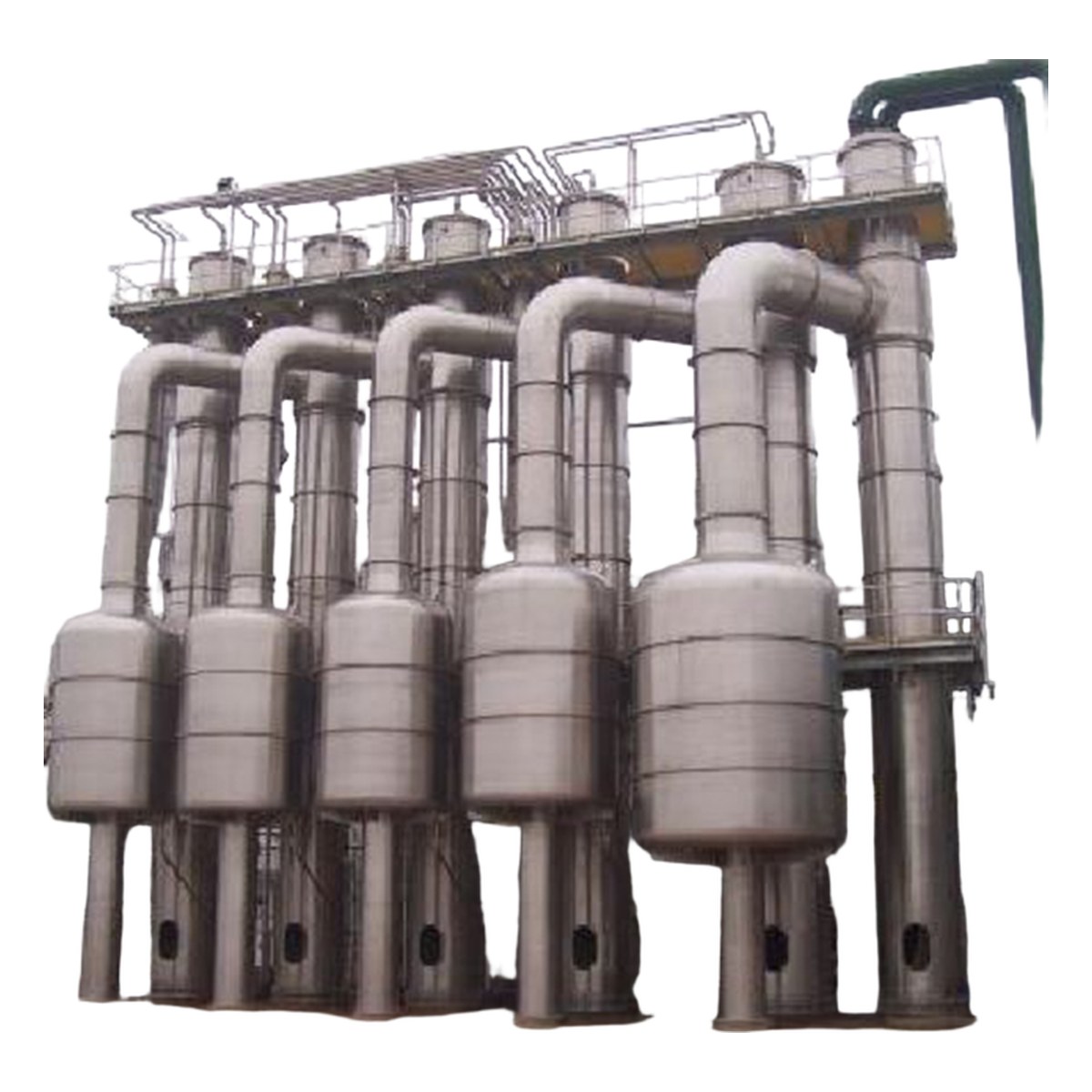
1. Product Overview
Falling film evaporators distribute feed liquid evenly onto the inner wall of heating tubes (or plates), where it flows downward as a thin film under gravity while being heated and evaporated. Features high heat-transfer coefficients, short residence time, and suitability for heat-sensitive materials.
2. Working Principle
Feed enters from the top and is evenly distributed to the inner walls of heating tubes, forming a thin film flowing downward. Heating steam condenses on the outside (or between plates), releasing heat; the feed evaporates rapidly inside the tubes. The vapor-liquid mixture enters a bottom separator; secondary vapor proceeds to the next effect or condenser, while concentrate is discharged from the bottom.
3. System Classification
Table
| Type | Features | Application |
|---|---|---|
| Atmospheric falling film | Simple structure, easy operation | Non-heat-sensitive materials |
| Vacuum falling film | Lower boiling point, gentle evaporation | Heat-sensitive materials, juice, pharma |
| Hygienic falling film | Mirror-polished interior, CIP/SIP | Food and pharma high-hygiene requirements |
4. Detailed Technical Parameters
4.1 Common Materials
Table
| Material | Application | Remarks |
|---|---|---|
| SS 304 / 316L | Product-contact parts | General food and pharma |
| Hastelloy | Highly corrosive media | Strong acids, chlorides |
| Titanium | Seawater, high chloride | Pitting and crevice corrosion resistant |
4.2 Typical Specifications (subject to design)
Table
| Parameter | Range |
|---|---|
| Heat transfer area | 2.5 ~ 100+ m² |
| Evaporation temperature | -10 °C ~ 200 °C (vacuum); -10 °C ~ 300 °C (atmospheric) |
| Operating pressure | Vacuum ~ 500 psi (34 bar) |
| Evaporation intensity | 100 ~ 300 kg/m²·h (process-dependent) |
| Feed viscosity | ≤ 500 cP (falling film type) |
4.3 Design Conditions & Performance
Table
| Parameter | Specification |
|---|---|
| Residence time | Several seconds to tens of seconds |
| Heat transfer coefficient | 800 ~ 2000 W/(m²·K) (material-dependent) |
| Dry solids concentration | up to 70% ~ 85% |
5. Electrical Parameters
(Same as MVR evaporator table)
6. Key Component Selection
Table
| Component | Common Brand / Material | Features |
|---|---|---|
| Distributor | SS 304 / 316L | Ensures uniform liquid film, prevents dry-out of the wall |
| Heating tubes / plates | SS 304 / 316L / Ti / Hastelloy | Thin-wall, high-efficiency heat transfer |
| Separator | SS 304 / 316L | Low entrainment design |
| Condenser | Custom-designed | Surface or direct-contact type |
7. Typical Applications
Food: Milk, juice, glucose syrup concentration
Pharmaceutical: Vitamins, antibiotics, traditional Chinese medicine extract concentration
Chemical: Solvent recovery, organic solution concentration
Environmental: Wastewater concentration, leachate treatment
8. Design Standards & Certifications
Table
| Standard | Description |
|---|---|
| ASME Section VIII Div.1 | Pressure vessel design and fabrication |
| ISO 9001:2015 | Quality management system |
| FDA / GMP | Food and pharmaceutical hygiene requirements |
| CE / PED | EU market access |
| GB 150 / GB/T 151 | Chinese pressure vessel and heat exchanger standards (if applicable) |
9. Optional Custom Configurations
Table
| Option | Details |
|---|---|
| Evaporation mode | Single-effect / Multi-effect combination |
| Surface finish | Mirror polish Ra ≤ 0.4 μm (hygienic grade) |
| CIP/SIP system | Automatic cleaning / sterilization |
| Material upgrade | Titanium, Hastelloy, duplex steel |
10. Warranty Terms
(Same as MVR evaporator)
11. Packaging and Delivery
Table
| Item | Packaging |
|---|---|
| Evaporator body | Tarpaulin wrap, wooden skid |
| Distributor / separator | Wooden cases |
| Electrical / instruments | Waterproof sealed packaging in wooden cases |
| Container estimate | Heat transfer area ≤50 m²: approx. 1×40'HC; larger by break bulk |
12. Information Required for Inquiry
12. Information Required for Quotation Material name, throughput, inlet/outlet concentration, viscosity, heat-sensitive temperature limit, solid content, available steam parameters, power supply, delivery terms, destination port.