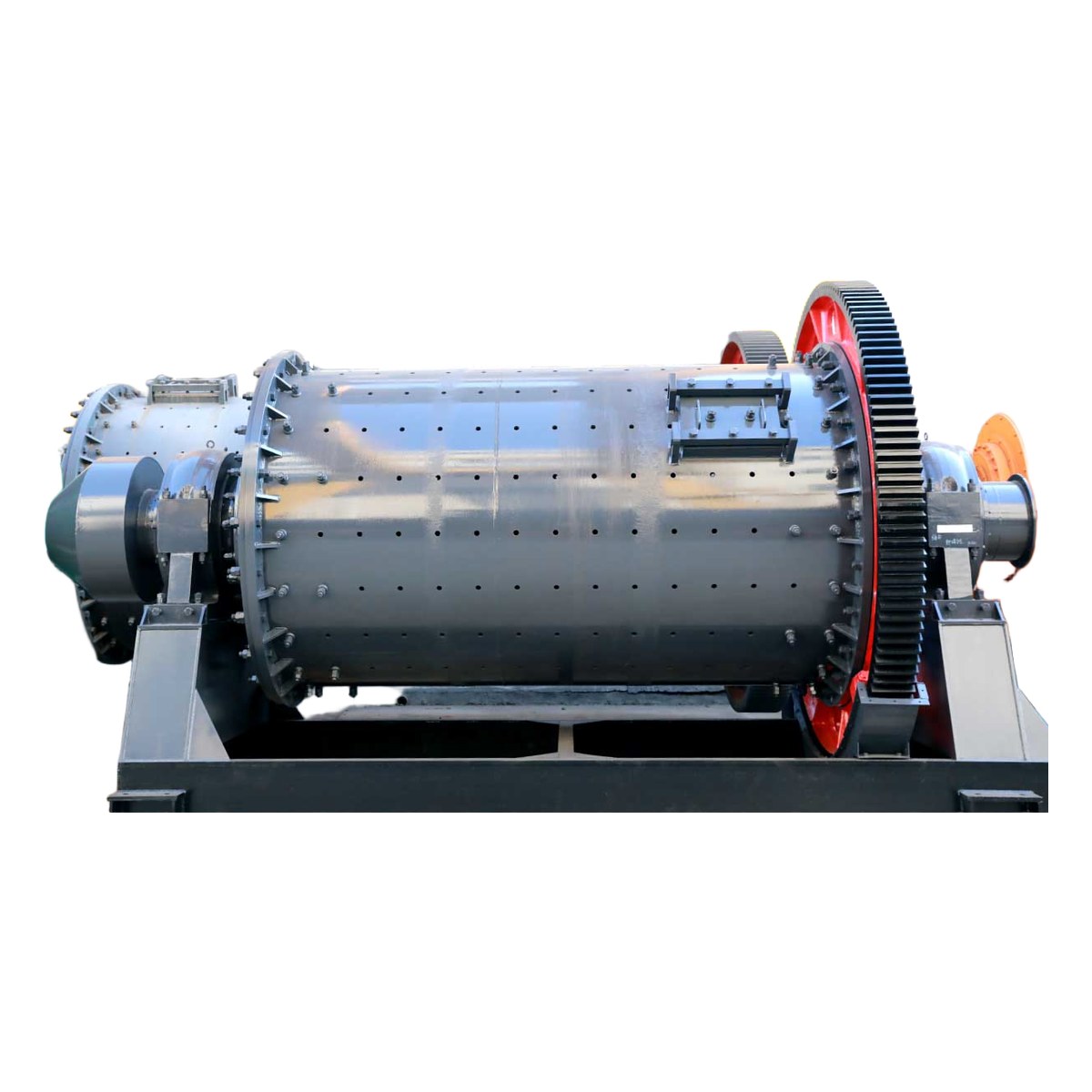
Ball Mill
1. Product Overview
1.1 General Description
The ball mill grinds material by the impact and abrasion of grinding media (steel balls, ceramic balls, zirconia balls, etc.) inside a rotating drum. As the drum rotates, the grinding media are lifted by centrifugal and frictional forces to a certain height and then fall freely, exerting intense impact and grinding action on the material. With a large grinding ratio, a wide range of applications and reliable operation, the ball mill is one of the most widely used grinding machines in the mining, building material, chemical and ceramic industries. Grinding media and liner materials of different compositions can be selected according to the material characteristics to avoid metal contamination.
1.2 Key Features
- Grinding ratio up to 300 or more
- Wide application range for materials of various hardness
- Choice of grinding media materials to avoid contamination
- Reliable operation and low maintenance cost
- Suitable for both dry and wet grinding
- Both continuous and batch operation possible
- Choice of liner materials to protect the drum
- Complete range of capacities
1.3 Document Scope
This technical specification covers the design principles, performance parameters, system classification, selection of core components, application fields, design standards and certifications, custom optional configurations, warranty terms, packaging and delivery, and the information required for inquiries of the ball mill, serving as a comprehensive reference for procurement selection and engineering communication.
2. Working Principle
2.1 Ball Mill Process Flow
Ball mill process flow: feeding + grinding media → drum rotation → grinding media lifted → free fall, impact and grinding → material is ground → discharge. The drum rotates at 65-80% of the critical speed; the grinding media are carried up the drum wall by centrifugal and frictional forces and, upon reaching a certain height, fall freely or cascade under gravity, impacting and abrading the material at the bottom. The impact force of the grinding media depends on the drop height and weight, while the grinding effect depends on the media size distribution and the filling rate (25-45%).
3. System Classification
| Classification | Typical models | Parameter range | Applications | Key features |
|---|
| Batch type | QM-5, QM-50, QM-200 | Volume 5-200 L | Laboratory/small batches | With discharge port |
| Continuous type | MQY-0.9, MQY-1.5, MQY-2.2 | Drum diameter 0.9-2.2 m | Large-scale production | Overflow/grate discharge |
4. Technical Parameters
4.1 Main Technical Parameters of the Ball Mill
| Parameter | QM-5 | QM-50 | QM-200 | MQY-0.9 | MQY-1.5 | MQY-2.2 |
|---|
| Drum volume (L) | 5 | 50 | 200 | - | - | - |
| Drum diameter (m) | - | - | - | 0.9 | 1.5 | 2.2 |
| Drum length (m) | - | - | - | 1.8 | 3.0 | 4.4 |
| Motor power (kW) | 0.75 | 2.2 | 7.5 | 22 | 75 | 200 |
| Speed (rpm) | 50 | 35 | 28 | 35 | 27 | 22 |
| Grinding media charge | 3 kg | 30 kg | 120 kg | 2 t | 10 t | 35 t |
| Capacity | - | - | - | 0.5-2 t/h | 2-8 t/h | 8-25 t/h |
4.2 Dimensions and Weight
| Model | Length (mm) | Width (mm) | Height (mm) | Net weight (kg) | Footprint (m²) |
|---|
| QM-5 | 600 | 500 | 600 | 50 | 0.3 |
| QM-50 | 800 | 700 | 900 | 150 | 0.6 |
| QM-200 | 1200 | 1000 | 1200 | 500 | 1.2 |
| MQY-0.9 | 3000 | 2000 | 1800 | 5000 | 6 |
| MQY-1.5 | 5000 | 3500 | 2500 | 15000 | 17.5 |
| MQY-2.2 | 7000 | 5000 | 3200 | 40000 | 35 |
5. Applications
| Application field | Typical materials | Special requirements | Representative products |
|---|
| Mining | Metallic/non-metallic ores | Large grinding ratio | Iron ore/copper ore |
| Building materials | Cement/lime/gypsum | High capacity | Cement raw materials |
| Ceramics | Ceramic raw materials/glazes | No metal contamination | Alumina powder |
| Chemical | Pigments/coating raw materials | Fine grinding | Pigment powder |
| Battery | Cathode and anode materials | No metal contamination | Lithium iron phosphate |
| Pharmaceutical | Chinese herbal ultrafine powder | Low-temperature grinding | Herbal ultrafine powder |
6. Core Component Selection
| Component | Function | Material | Selection notes |
|---|
| Drum | Contains the material and grinding media | Q235/stainless steel/rubber lining | Wall thickness calculated from the diameter |
| Grinding media | Impact and abrade the material | Steel balls/ceramic balls/zirconia balls | Size distribution affects the grinding result |
| Liner | Protects the drum | Manganese steel/rubber/ceramic | Replace when worn |
| Main bearings | Support the drum | Plain bearings/rolling bearings | Forced lubrication required |
| Transmission | Drives the drum rotation | Gear reducer + gears | Ring gear checked regularly |
| Feed device | Feeding | Chute/screw feeder | Feed rate to be controlled |
| Discharge device | Discharge | Overflow/grate/hollow shaft | Type selected according to the process |
7. Design Standards and Certifications
| Standard/Certification | Scope | Compliance | Certificate/Report |
|---|
| Relevant GB/T standards | Design and manufacture | Fully compliant | Type inspection report |
| GMP (cGMP) | Design, manufacture, documentation | Fully compliant | GMP compliance certificate |
| ISO 9001:2015 | Quality management system | Certified | ISO 9001 certificate |
| CE certification | Machinery safety/EMC | Optional | CE declaration of conformity |
| FDA | Food-grade/pharmaceutical-grade | Optional | FDA compliance documents |
8. Custom Optional Configurations
| No. | Custom item | Options | Default | Impact on delivery |
|---|
| 1 | Grinding media | Steel balls/ceramic balls/zirconia balls | Steel balls | Zirconia +2 weeks |
| 2 | Liner material | Manganese steel/rubber/ceramic/polyurethane | Manganese steel | Ceramic +3 weeks |
| 3 | Operation mode | Dry/wet grinding | Dry | Wet +1 week |
| 4 | Discharge method | Overflow/grate/hollow shaft | Overflow | Grate +1 week |
| 5 | Explosion protection | Standard/nitrogen inerting | Standard | Nitrogen +2 weeks |
9. Material Property Requirements
| Material characteristic | Requirement | Remarks |
|---|
| Working temperature | -40~250℃ | Depends on the seals and materials |
| Corrosiveness | Mild to moderate corrosion | 316L or lining required for strong corrosion |
| Explosion protection | Selected according to the site | Zone1/Zone2 different levels |
10. Warranty Terms
| Warranty category | Period | Coverage | Conditions |
|---|
| Main equipment warranty | 12 months | All components included | 12 months from successful commissioning |
| Extended warranty (optional) | 24 months | Same as the standard warranty | Must be purchased with the order |
| Wear parts warranty | 6 months | Seals, bearings, etc. | Normal wear excluded |
11. Packaging and Delivery
| Item | Details |
|---|
| Standard lead time | 6-10 weeks after order confirmation |
| Custom configuration lead time | 10-16 weeks |
| Incoterms | FOB Shanghai / CIF / DAP |
| Packing | Export wooden case |
| Shipping | Container or break-bulk vessel |
12. Information Required for Inquiry
| No. | Information required | Description/Example |
|---|
| 1 | Material name and hardness | Mohs hardness/max. feed size |
| 2 | Target discharge size | mesh or μm |
| 3 | Capacity required | kg/h or t/h |
| 4 | Dry/wet grinding | Dry/wet |
| 5 | Grinding media preference | Steel/ceramic/zirconia |
| 6 | Metal contamination limit | Yes/No |
| 7 | Liner material preference | Manganese steel/rubber/ceramic |
| 8 | Installation conditions | Space/load-bearing/power |