Bucket Elevator
Conveying Equipment
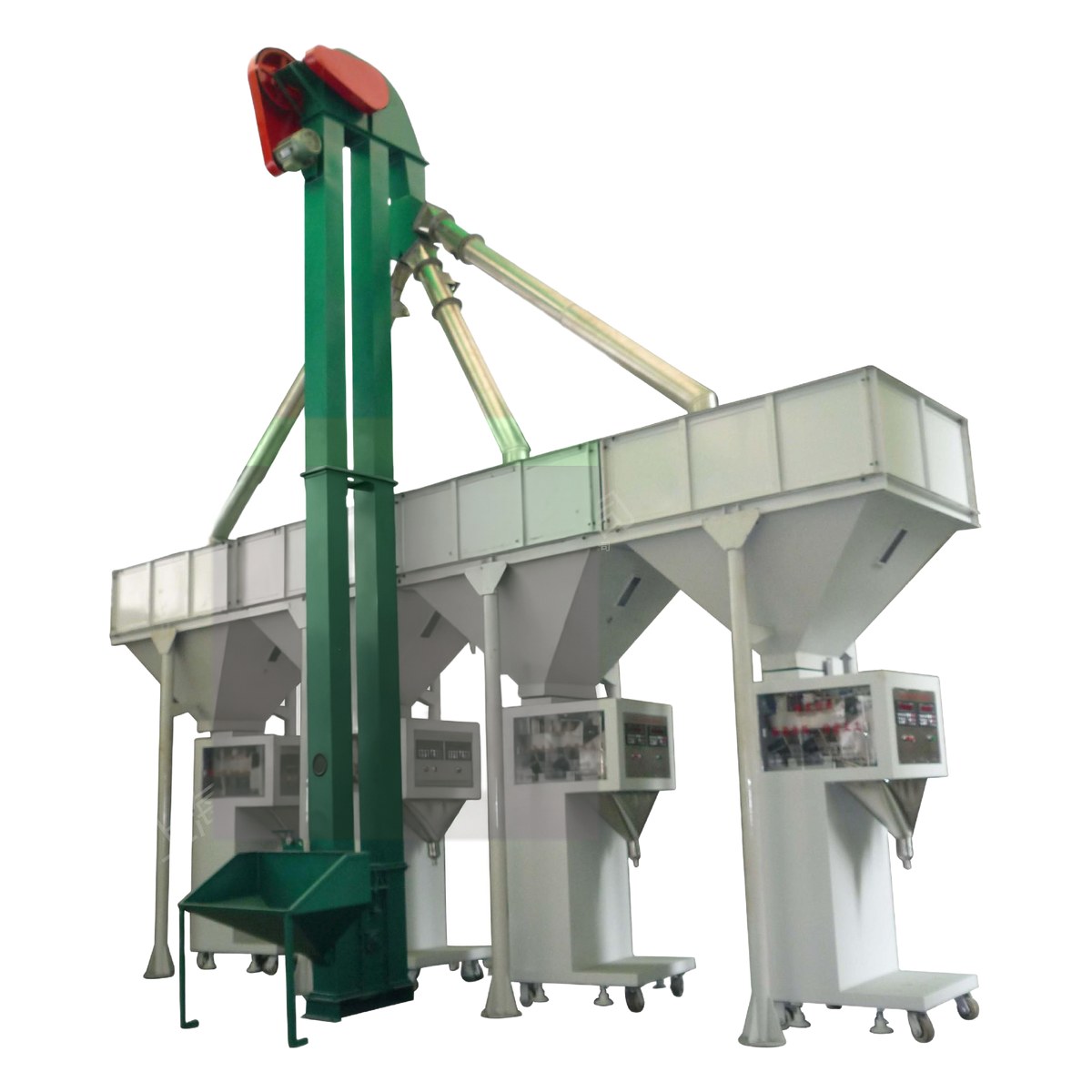
Bucket Elevator
1. Product Overview
A bucket elevator is a continuous conveying machine that utilizes a series of buckets uniformly fixed to an endless rubber belt or steel wire rope belt, which lifts bulk materials from the bottom to the top as the belt moves upward. It is one of the most widely used vertical lifting devices in industrial production, featuring compact structure, small footprint, large lifting height, good sealing performance, and minimal environmental pollution. It is extensively applied in industries such as grain, chemical, building materials, metallurgy, electric power, and pharmaceuticals.
The working principle involves an electric motor driving the upper main wheel shaft through a reducer, which in turn drives the endless belt and the buckets fixed to it. The buckets scoop up material at the bottom, carry it upward, and at the top, the material is thrown out by centrifugal force and gravity and discharged through the discharge port. The empty buckets then return to the bottom along the return side to complete one cycle. During operation, the material is carried only inside the buckets without direct contact with the running mechanism, resulting in low wear and low material breakage rate.
Bucket elevators can be customized according to material characteristics, lifting capacity, lifting height, and other parameters, supporting multiple combinations of bucket types, belt types, and drive modes to adapt to various working conditions from small to large capacity, from low to high temperature, and from standard to explosion-proof requirements.
2. Working Principle
The core motion mechanism of a bucket elevator is a closed-loop bucket belt system composed of an upper drive wheel, lower tension wheel, endless belt, and buckets. The electric motor drives the upper main wheel shaft through a reducer. The sprocket teeth on the main wheel mesh with the endless belt (steel wire rope belt type) or rely on friction (rubber belt type) to drive the belt. The buckets are uniformly fixed to the belt and move together with it.
In the lower feeding area, the buckets scoop up material from the base through digging action; during upward travel, the material is carried upward by the buckets; when the buckets pass over the top of the main wheel, the material is thrown out by the combined action of centrifugal force and gravity, and discharged through the discharge port into downstream equipment or storage containers. The empty buckets travel down the return side back to the bottom to reload, thus completing continuous vertical lifting of material.
Based on the discharge method, bucket elevators are classified into two basic types: centrifugal discharge and gravity discharge. Centrifugal discharge elevators operate at higher speeds (typically 1.2 to 2.0 m/s), using centrifugal force to throw material from the buckets, suitable for free-flowing bulk materials. Gravity discharge elevators operate at lower speeds (typically 0.4 to 1.0 m/s), where material slowly slides out mainly by gravity, suitable for lumpy and chunky materials.
3. System Classification
3.1 Classification by Discharge Method
Centrifugal discharge bucket elevator: Uses higher operating speed and centrifugal force for discharge, suitable for dry powdered, granular, and small lump bulk materials such as cement, coal, ore, chemical fertilizer, and grain. This type features fast speed, large capacity, and high efficiency, but causes greater material breakage.
Gravity discharge bucket elevator: Uses lower operating speed and relies on gravity for discharge, suitable for lumpy and chunky materials such as limestone, coke, and large ore. This type operates smoothly with low material breakage, but has relatively smaller conveying capacity.
3.2 Classification by Belt Type
Rubber belt type: Uses high-strength rubber belt for transmission, with teeth on the belt meshing with the drive wheel. It operates smoothly with low noise, suitable for medium-low lifting heights and medium conveying capacities. The rubber belt has good elasticity and abrasion resistance but is not suitable for high-temperature environments.
Steel wire rope belt type: Uses steel wire rope belt for transmission, featuring high strength, high temperature resistance, and minimal elongation, suitable for large lifting heights, large conveying capacities, and high-temperature materials. This type has a robust structure and long service life, making it the most widely used type in the industrial field.
Chain type: Uses chain transmission, with buckets fixed to the chain. It has good running stability and strong adaptability, suitable for steep-angle lifting and special working conditions. Chain-type elevators can achieve steep-angle conveying, but have more complex structure and higher maintenance costs.
3.3 Classification by Bucket Type
Deep bucket type: Buckets have greater depth, suitable for centrifugal discharge, can convey free-flowing materials such as powder and granules. The bottom of the bucket is usually circular, facilitating material filling and discharge.
Shallow bucket type: Buckets have shallower depth, suitable for gravity discharge, can convey lumpy and chunky materials. The bottom is usually flat, allowing material to slide out by gravity.
Medium-deep bucket type: Bucket depth is between deep and shallow buckets, accommodating both centrifugal and gravity discharge methods, suitable for mixed materials or variable working conditions.
4. Detailed Technical Parameters
4.1 Basic Parameters
| Parameter | Value | Remarks |
|---|---|---|
| Model | TD250/TD315/TD400/TD500/TD630 | Corresponding bucket width(mm) |
| Lifting height | 5-40 m | Customized per requirement |
| Conveying capacity | 15-300 m³/h | Depends on model and material |
| Bucket speed | 1.0-2.0 m/s(centrifugal)/0.4-1.0 m/s(gravity) | Per discharge method |
| Bucket spacing | 200-500 mm | Adjusted per bulk density |
| Bucket volume | 2.5-45 L | Depends on model |
| Drive wheel diameter | 400-1000 mm | Per model configuration |
| Motor power | 3-55 kW | Per height and capacity |
4.2 Rubber Belt Type Technical Parameters
| Parameter | TD250 | TD315 | TD400 | TD500 | TD630 |
|---|---|---|---|---|---|
| Bucket width(mm) | 250 | 315 | 400 | 500 | 630 |
| Bucket volume(L) | 2.5 | 4.2 | 6.7 | 10.5 | 16.8 |
| Bucket spacing(mm) | 300 | 350 | 400 | 400 | 450 |
| Belt speed(m/s) | 1.6 | 1.6 | 1.6 | 1.6 | 1.6 |
| Capacity(m³/h) | 18 | 28 | 42 | 65 | 95 |
| Max lifting height(m) | 30 | 35 | 40 | 40 | 35 |
| Drive wheel dia.(mm) | 400 | 500 | 630 | 630 | 800 |
| Motor power(kW) | 3-7.5 | 4-11 | 5.5-15 | 7.5-22 | 11-30 |
4.3 Steel Wire Rope Belt Type Technical Parameters
| Parameter | TH250 | TH315 | TH400 | TH500 | TH630 | TH800 |
|---|---|---|---|---|---|---|
| Bucket width(mm) | 250 | 315 | 400 | 500 | 630 | 800 |
| Bucket volume(L) | 3.0 | 5.0 | 8.0 | 12.5 | 20.0 | 35.0 |
| Bucket spacing(mm) | 300 | 350 | 400 | 450 | 500 | 500 |
| Belt speed(m/s) | 1.4 | 1.4 | 1.4 | 1.4 | 1.4 | 1.4 |
| Capacity(m³/h) | 20 | 35 | 55 | 85 | 130 | 220 |
| Max lifting height(m) | 35 | 40 | 45 | 50 | 50 | 40 |
| Drive wheel dia.(mm) | 500 | 630 | 800 | 800 | 1000 | 1000 |
| Motor power(kW) | 4-11 | 5.5-15 | 7.5-22 | 11-30 | 15-45 | 22-55 |
4.4 Overall Dimension Reference
| Model | Casing W(mm) | Casing D(mm) | Feed inlet(mm) | Discharge outlet(mm) | Weight(kg/m) |
|---|---|---|---|---|---|
| TD250 | 420 | 320 | 250x200 | 250x250 | 65-85 |
| TD315 | 510 | 380 | 315x250 | 315x300 | 80-110 |
| TD400 | 620 | 460 | 400x300 | 400x350 | 100-140 |
| TD500 | 740 | 540 | 500x350 | 500x400 | 130-180 |
| TD630 | 900 | 660 | 630x400 | 630x450 | 180-250 |
4.5 Material Characteristics Parameters
| Material Category | Bulk Density(t/m³) | Particle Size(mm) | Recommended Discharge | Max Temp(°C) |
|---|---|---|---|---|
| Grain/Food | 0.5-0.8 | ≤0.1 | Centrifugal | 60 |
| Cement/Mineral Powder | 1.0-1.6 | ≤0.05 | Centrifugal | 80 |
| Coal/Coke | 0.6-0.9 | ≤50 | Centrifugal/Gravity | 120 |
| Chemical Fertilizer | 0.8-1.2 | ≤6 | Centrifugal | 80 |
| Limestone/Gravel | 1.3-1.8 | ≤60 | Gravity | 200 |
| Refractory Material | 1.0-2.0 | ≤50 | Gravity/Centrifugal | 350 |
5. Core Component Selection
5.1 Running Belt
The running belt is the core transmission component of the bucket elevator, directly affecting operational stability and service life. Rubber belts are made of high-strength nylon canvas layers, with a wear-resistant rubber layer on the surface and teeth on the edges that mesh with the drive wheel for smooth non-slip transmission. Steel wire rope belts feature a multi-strand steel wire rope core covered with a wear-resistant rubber layer, where the rope core bears the main tensile load and the outer rubber provides protection and transmission assurance.
5.2 Buckets
Buckets are the components that directly carry materials, and their shape and material directly affect conveying efficiency and material integrity. They are typically made of Q235 carbon steel plate by press forming and welding, with optional wear-resistant rubber lining or anti-corrosion coating on the surface. Stainless steel plate is used for food-grade applications, and heat-resistant steel or refractory castings for high-temperature environments. Bucket-to-belt connection methods include bolted fixing (rubber belt type) and wedge clamp fixing (steel wire rope belt type).
5.3 Drive Unit
The drive unit includes motor, reducer, coupling, and protective cover. The motor is typically a Y-series three-phase asynchronous motor, and the reducer uses a worm gear or hard-surface gear type, with appropriate power selected according to conveying capacity and lifting height. The drive unit is located on the side of the upper drive wheel, connected by an elastic coupling that effectively cushions impact loads during starting and braking. Common brands include SEW, NORD, and Guomao.
5.4 Tension Device
The tension device ensures proper belt tension, preventing belt slippage and misalignment. Common tension types include counterweight, screw, and pneumatic. Counterweight tensioning has a simple and reliable structure but non-adjustable tension force; screw tensioning allows precise tension adjustment and convenient maintenance; pneumatic tensioning automatically compensates for belt elongation with constant tension, suitable for large-scale elevators.
5.5 Casing
The casing adopts a closed structure, effectively preventing dust overflow and material spillage. It is typically made of Q235 carbon steel plate by welding, with internal guide rails or guide strips to prevent belt misalignment. Depending on material characteristics, observation windows, access doors, and cleaning ports can be provided. Food-grade applications use stainless steel casings, and explosion-proof applications use explosion-proof casings meeting the corresponding explosion-proof rating requirements.
6. Typical Application Fields
Building materials industry: Used for vertical lifting of raw materials and finished products such as cement clinker, slag, limestone, and coal. It is one of the most important application fields for bucket elevators. Building materials are typically highly abrasive and at high temperatures, requiring wear-resistant buckets and high-temperature resistant belts.
Chemical industry: Used for vertical conveying of chemical raw materials such as fertilizers, caustic soda, salt, and activated carbon. Chemical materials often have corrosive or hygroscopic properties, requiring anti-corrosion materials or sealed structures.
Grain industry: Used for vertical lifting of wheat, corn, soybeans, rice, and other grain crops. It requires material safety, no contamination, and good sealing, typically using stainless steel buckets and food-grade rubber belts.
Metallurgical industry: Used for lifting and conveying metallurgical raw materials such as ore, coke, coal powder, and sintered ore, characterized by high abrasiveness, high temperature, and heavy loads, typically using steel wire rope belt type elevators.
Power industry: Used for coal conveying and ash removal systems in thermal power plants, requiring stable and reliable operation, good sealing, and minimal maintenance.
Pharmaceutical industry: Used for vertical conveying of drug raw materials, excipients, and intermediates, requiring compliance with GMP standards, safe materials, no dead corners, easy cleaning, and good sealing.
7. Design Standards and Certifications
7.1 National Standards
GB/T 19001 - Quality management system requirements, ensuring full-process quality control from design and production to service. GB/T 10595 - Belt conveyor technical conditions, specifying design, manufacturing, installation, and acceptance requirements for conveying machinery. JB/T 3926 - Bucket elevator technical conditions, specifically specifying type parameters, technical requirements, and test methods for bucket elevators.
7.2 Industry Standards
JB/T 8853 - Cylindrical gear reducer technical conditions, specifying reducer technical requirements and test methods. JB/T 7330 - Bucket elevator connection structure types and dimensions, specifying bucket-to-belt connection structure and dimension requirements.
7.3 International Standards
ISO 9001 - International certification for quality management systems. CE certification - EU market entry requirement, ensuring products comply with EU safety, health, and environmental protection requirements.
7.4 Special Certifications
Explosion-proof certification (Ex) - Applicable to combustible and explosive material scenarios such as coal and grain, designed and manufactured per GB 3836 standards. Food safety certification - Applicable to grain and food processing scenarios, with materials meeting food contact standard requirements.
8. Customizable Options
| Configuration Item | Options | Application Scenario |
|---|---|---|
| Belt type | Rubber belt/Steel wire rope belt/Chain | Per height, load, temperature |
| Bucket type | Deep/Shallow/Medium-deep | Per material and discharge method |
| Bucket material | Carbon steel/Stainless steel/Heat-resistant/Refractory | Per corrosion and temperature |
| Casing material | Carbon steel/Stainless steel/Explosion-proof | Per environment requirements |
| Tension type | Counterweight/Screw/Pneumatic | Per belt type and equipment size |
| Drive mode | Left drive/Right drive/Dual drive | Per site layout and power |
| Explosion-proof grade | Ex d IIC T4 / Ex d IIB T4 | Combustible/explosive materials |
| Cleaning device | Spiral cleaner/Vibration cleaner | Sticky or caking materials |
| Safety protection | Anti-deviation switch/Speed monitor/Backstop | Safety and automation control |
| Sealing type | Standard seal/Gas seal/Liquid seal | Toxic, dusty, or sluggish materials |
9. Warranty Terms
9.1 Warranty Period
The warranty period for the complete machine is twelve months from the date of acceptance. The warranty period for main structural components (casing, drive wheel, driven wheel) is twenty-four months. The warranty period for consumable parts such as belts and buckets is six months. During the warranty period, quality problems caused by product design, manufacturing, or materials shall be repaired or replaced free of charge by the supplier.
9.2 Warranty Scope
Under normal use and maintenance conditions, failures caused by inherent product quality defects, including but not limited to structural deformation, abnormal wear, and material failure, are within the warranty scope. Damage caused by improper operation, use beyond specifications, unauthorized modification, or force majeure is not covered by warranty.
9.3 After-sales Service
The supplier provides lifelong technical support services, including telephone consultation, remote diagnosis, and on-site service. Upon receiving user fault notification, the supplier shall respond within 24 hours and arrive on-site within 48 hours (domestic). Post-warranty paid technical services and spare parts supply are available.
10. Packaging and Delivery
10.1 Packaging Method
The complete machine is disassembled into upper section, middle casing section, lower section, bucket-belt assembly, and drive unit for separate packaging. Each component is packed in wooden cases or iron frames, with foam, rubber, and other cushioning materials inside to prevent transportation collision. Precision components (motor, reducer, instruments) are sealed and moisture-proof packaged.
10.2 Delivery Period
Standard model delivery period is 45-60 working days after contract signing. Non-standard or specially customized product delivery period is subject to separate negotiation. Delivery includes product certificate, operation manual, and packing list.
10.3 Transportation Requirements
During transportation, severe vibration, collision, and moisture should be prevented. Extra-long components (casing sections) should use special transport vehicles with clear oversized markings. Equipment should avoid outdoor storage; if outdoor storage is necessary, rain protection measures should be taken.
11. Information Required for Inquiry
To ensure accurate equipment selection and quotation, please provide the following information when inquiring:
| No. | Information Item | Description |
|---|---|---|
| 1 | Material name and characteristics | Including name, bulk density, particle size, moisture, temperature, corrosiveness, etc. |
| 2 | Required conveying capacity | Maximum and average capacity per unit time (m³/h or t/h) |
| 3 | Lifting height | Vertical distance from feed inlet to discharge outlet (m) |
| 4 | Discharge method | Centrifugal, gravity, or mixed type |
| 5 | Installation site conditions | Space limitations, floor height, foundation bearing capacity, etc. |
| 6 | Environmental requirements | Whether explosion-proof, food-grade, sealed, or other special requirements |
| 7 | Power supply conditions | Voltage rating, frequency, protection level requirements |
| 8 | Other special requirements | Such as preventing material breakage, multi-point feeding, multi-point discharging, etc. |