Three-in-One Filtration, Washing & Drying Unit
Other Equipment
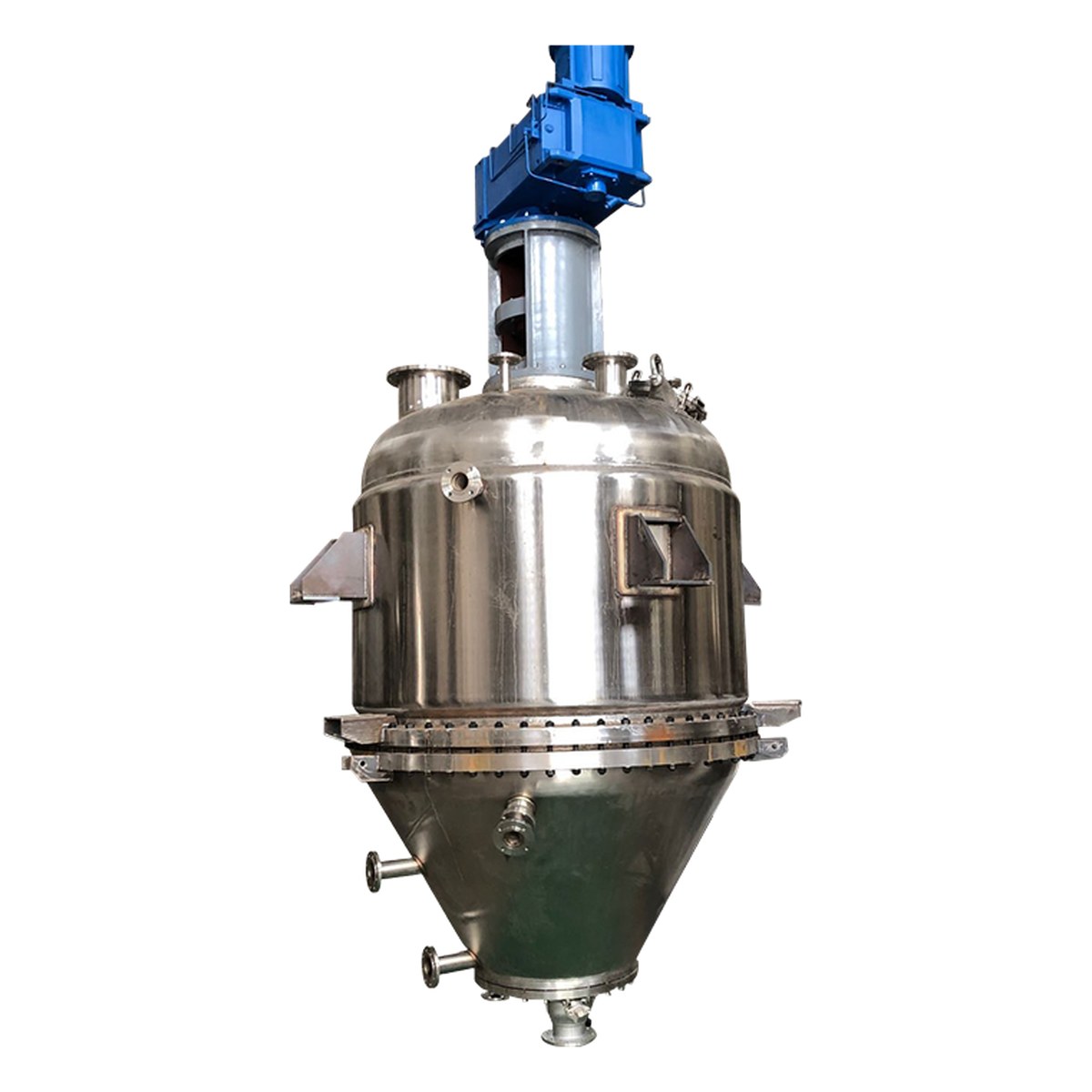
1. Product Overview
The Three-in-One Filtration, Washing & Drying Unit (also known as a filter washing dryer or "three-in-one" multifunctional machine, in English: pharmaceutical agitated nutsche filter dryer) is a multifunctional pharmaceutical and chemical unit that performs the three steps of filtration, washing and drying in sequence inside the same closed vessel. It consists of a shell with a heating/cooling jacket, a retractable or removable base plate, a filter plate (perforated plate + filter cloth or stainless steel sintered metal mesh), a lifting agitator (combining agitation, reslurrying, cake turning and scraping discharge), a discharge valve, vacuum and heating medium circulation system ports, CIP/SIP ports and an electrical and PLC control system. A single machine replaces the suction filter, filter press, double-cone rotary dryer and drying oven; the material is processed in the same closed vessel from beginning to end with no transfer, thereby significantly increasing yield, shortening the production cycle and reducing solvent loss and operator contact. It is widely used for APIs and pharmaceutical intermediates, fine chemicals, pesticides and veterinary drugs, dyes and pigments, food additives, new energy lithium battery materials and biological products. Equipment features: three process steps in one machine, fully closed operation, high vacuum contact drying efficiency, uniform drying without dead corners, low filter cake moisture content, optional aseptic grade design and automatic CIP/SIP program, in compliance with GMP requirements.
2. Working Principle
Filtration stage: the suspension is pressure-fed by nitrogen or drawn by vacuum into the filtration zone of the shell; the filtrate passes through the filter cloth or sintered metal mesh and is discharged through the filtrate port in the base plate, while the solids build up on the surface of the filter medium to form a filter cake reaching a thickness of 300~500 mm. Washing stage: the washing liquid is distributed evenly through the spray pipe (spray washing), or the agitator is lowered and rotated at low speed to reslurry the cake (reslurry washing), or washing liquid is used to displace the mother liquor held in the cake pores (displacement washing), followed by renewed dewatering; this can be repeated several times until impurity residues meet the specification. Drying stage: a heating medium (hot water, steam or thermal oil) is introduced into the base plate and shell jacket, the vessel interior is evacuated (or purged with nitrogen), and the agitator rotates at low speed to continuously turn the filter cake so that water or organic solvent evaporates under vacuum at low temperature; the vapor is condensed and recovered in the condenser. After drying, the agitator descends to scrape and collect the material, which is discharged through the discharge valve, or the hydraulic system lowers and tilts the base plate to discharge the product.
3. System Classification
Classified by structural type and discharge method:
Vertical fixed base plate three-in-one: the base plate is fixed and the material is discharged through a side or bottom discharge valve / small and medium volumes, conventional APIs and intermediates
Vertical removable base plate three-in-one: a hydraulic cylinder lowers, withdraws and tilts the base plate for discharge, leaving no dead corners for cleaning and maintenance / toxic and hazardous or flammable and explosive materials, products with high GMP cleanliness and aseptic requirements
Horizontal three-in-one: the shell is arranged horizontally with a horizontal agitator shaft, allowing a larger volume and filtration area / large throughput, large-batch production conditions
Classified by drying method: vacuum contact drying type / vacuum + jacket heating medium heating type / aseptic grade (SIP) type / solvent recovery type
4. Detailed Technical Parameters
4.1 Common Materials of Construction
| Material | Applicable parts | Remarks |
|---|---|---|
| 304 stainless steel | Shell, base plate, agitator, filter plate | General-purpose type, suitable for common chemical and food applications |
| 316L stainless steel | Shell, base plate, agitator, filter plate | First choice for pharmaceutical and fine chemical service, excellent corrosion resistance |
| Duplex stainless steel 2205 | Shell, base plate, agitator | Resistant to chloride ions and stress corrosion, long service life |
| Titanium (TA2) / Hastelloy C-276 | Shell, base plate, filter plate | For strongly corrosive media, optional as required, high cost |
| Carbon steel + PTFE lining / rubber lining | Shell inner wall, base plate | For strong acid service, combining strength with corrosion resistance |
4.2 Typical Specification Table
| Nominal volume (L) | Filtration area (m²) | Shell inner diameter (mm) | Agitator power (kW) | Drying temperature (℃) | Discharge method |
|---|---|---|---|---|---|
| 100~300 | 0.3~0.8 | Φ600~800 | 1.5~3 | ≤150 | Side discharge port |
| 500~1000 | 1.0~2.5 | Φ1000~1200 | 3~7.5 | ≤150 | Side discharge / base plate lifting |
| 1500~3000 | 3~6 | Φ1400~1800 | 7.5~15 | ≤180 | Retractable & tilting base plate |
| 4000~6000 | 8~12 | Φ2000~2400 | 15~22 | ≤180 | Retractable & tilting base plate |
| 8000~10000 | 15~20 | Φ2400~2800 | 22~37 | ≤180 | Retractable & tilting base plate / tilting discharge |
4.3 Design Conditions and Performance Indicators
| Parameter | Specification |
|---|---|
| Design pressure | Shell: -0.1~0.6 MPa; jacket: 0.3~0.6 MPa |
| Design temperature | -20~200℃ (heating medium heating type, depending on material of construction and operating conditions) |
| Drying vacuum level | ≥-0.09 MPa (vacuum contact drying) |
| Filter cake thickness and final moisture content | Filter cake thickness ≤500 mm; moisture content after drying can reach ≤0.5% (depending on material and process) |
| Filtration accuracy | Filter cloth 5~100 μm; sintered metal mesh 1~50 μm |
| Surface treatment and sealing | Internal surface Ra≤0.4 μm (aseptic grade can reach Ra≤0.2 μm); mechanical seal + nitrogen blanketing port |
5. Electrical Parameters
| Applicable region | Voltage | Frequency |
|---|---|---|
| China / Russia / Central Asia | 380V | 50Hz |
| Middle East / Southeast Asia / Africa | 400V / 415V | 50Hz |
| South Korea | 380V | 60Hz |
| Americas (if required) | 440V / 480V | 60Hz |
| Explosion-proof configuration (optional) | ExdⅡBT4 / ExdⅡCT4 | — |
| Note: voltage, frequency and explosion-proof requirements must be specified for the agitator motor, hydraulic station, vacuum pump, heating medium circulation pump and control cabinet. |
6. Selection of Core Components
| Component | Common brand / material | Features and application |
|---|---|---|
| Filter medium | Customized (filter cloth / sintered metal mesh) | Filter cloth is low in cost and easy to replace; sintered mesh offers high strength, stable accuracy and can be regenerated by back-blowing |
| Agitation and scraper system | Customized (304/316L blades + scraper, hydraulic / screw lifting) | Reslurry washing, cake turning to intensify drying, scraping discharge, with variable frequency speed control |
| Base plate sealing and quick-opening clamping | Silicone rubber / fluoro rubber / PTFE seal + clamp or tooth-engagement quick opening | Ensures tightness under vacuum and pressure; removable base plate models are equipped with a hydraulic lifting trolley |
| Vacuum and condensate recovery system | Quality domestic brand / customer-specified brand | Liquid ring vacuum pump or dry vacuum pump + shell-and-tube / spiral condenser, for organic solvent recovery |
| Heating medium circulation and temperature control | Quality domestic brand | Jacket heating with hot water, steam or thermal oil; PID temperature control; uniform drying temperature |
| Instrumentation and control (optional) | Siemens, E+H, quality domestic brands | Monitoring of pressure, temperature, level, vacuum level and weighing; PLC + touch screen, remote monitoring available |
7. Typical Application Fields
APIs and pharmaceutical intermediates: filtration, washing and vacuum drying after reaction and crystallization completed in a single machine, meeting GMP and aseptic requirements
Fine chemicals and pesticides: toxic, hazardous, flammable and explosive materials handled under fully closed conditions, with nitrogen blanketing and explosion-proof configuration
Dyes, pigments and food additives: reduced material transfer and solvent loss, improved yield and batch-to-batch consistency
New energy materials: filtration, washing and drying of lithium battery cathode material precursors, ternary materials and similar products
Solvent recovery applications: organic solvent evaporated during the drying step is condensed and recovered, reducing consumption and emissions
8. Design Standards and Certification
| Standard | Description |
|---|---|
| JB/T 20099-2022 | Pharmaceutical filtration, washing and drying machine (three-in-one, current, replacing JB/T 20099-2007) |
| JB/T 12061-2014 | Filtration, washing and vacuum drying machine (pharmaceutical machinery industry standard) |
| GB/T 150.1~150.4-2024 | Pressure vessels (general requirements, materials, design, manufacturing inspection and acceptance) |
| TSG 21-2016 | Safety Technical Supervision Regulation for Stationary Pressure Vessels |
| GB/T 36030-2018 | General technical requirements for in-place cleaning and sterilization of pharmaceutical machinery (equipment) (CIP/SIP) |
| GB/T 36036-2018 | Guideline for validation of cleaning and sterilization of pharmaceutical machinery (equipment) |
| NB/T 47013-2015 | Nondestructive testing of pressure equipment |
| JB/T 20188-2017 | Method for compiling model designations of pharmaceutical machinery products |
| GMP (2010 Revision) | Good Manufacturing Practice for pharmaceutical products (pharmaceutical applications) |
| ISO 9001:2015 / CE / EAC / GOST-R | Quality management system; CE, EAC and GOST-R can be obtained according to market requirements |
9. Optional Customization
| Option | Details |
|---|---|
| Specification customization | Nominal volume 50~10000 L; filtration area 0.2~20 m² |
| Discharge method | Fixed base plate side discharge / retractable & tilting base plate / tilting discharge |
| Heating and drying | Jacket heating with hot water, steam or thermal oil; vacuum contact drying + condensate recovery |
| Material and surface | 304 / 316L / duplex steel / titanium / Hastelloy; internal surface polished to Ra≤0.4 μm, aseptic grade can reach Ra≤0.2 μm |
| Safety and automation | Nitrogen blanketing, explosion-proof motor, PLC + touch screen, automatic drying program control, weighing and metering, automatic CIP/SIP program |
10. Warranty Terms
| Equipment condition | Warranty period | Warranty scope |
|---|---|---|
| New equipment | 12 months | Shell, base plate, agitation and scraper system, filter plate, seals, valves, vacuum and heating medium systems |
| Refurbished equipment | 6 months | Shell, base plate, agitation and scraper system, filter plate, seals, valves, vacuum and heating medium systems |
| Idle equipment (as-is supply) | 3 months | Main functional components |
11. Packaging and Delivery
| Item | Packaging method |
|---|---|
| Equipment body | Fastened with steel straps on a wooden pallet, flange faces fitted with protective covers, nozzles fitted with protective caps |
| Agitator and lifting / scraper parts | Packed separately in wooden cases to prevent impact and deformation |
| Filter plate and filter cloth / sintered mesh | Packed flat, filter cloth sealed against moisture |
| Vacuum, heating medium and condensing parts | Packed in separate wooden cases, pipe ends fitted with protective caps |
| Control cabinet and hydraulic station | Packed in wooden cases, desiccant placed inside the control cabinet |
| Documentation supplied | Certificate of conformity, material certificates, pressure test report, operation manual, spare parts list, GMP-related documents |
| Container capacity estimate | Below 1000 L: approx. 1 x 20-ft container holding 2~3 units; around 3000 L: approx. 1 x 20-ft container holding 1 unit; above 6000 L: a 40-ft container or break bulk vessel is recommended |
| Installation service | On-site installation guidance and commissioning can be provided; technicians can be dispatched for large projects (travel, accommodation and meal costs borne by the buyer) |
12. Information Required for Inquiry
12. Information Required for Inquiry Material name, solids content and solid particle size; liquid phase properties (corrosiveness, viscosity, whether flammable or explosive, whether organic solvent is present); required throughput or batch charge; requirements for filter cake thickness and final moisture content; washing method, type of washing liquid and required number of washing cycles; upper limit of drying temperature and permissible drying time; whether solvent condensation recovery is required and the type of solvent; required nominal volume and filtration area of the equipment (if known); material requirements (shell, base plate, agitator, filter medium); discharge method and installation space limitations; whether a heating jacket and heating medium conditions are required (hot water / steam / thermal oil); whether nitrogen blanketing, explosion protection and CIP/SIP are required, and whether an aseptic grade design is required; local voltage and frequency; equipment condition preference: new / refurbished / idle; delivery terms: FOB/CIF/DDP; destination port or delivery address (for freight calculation).