Distillation System
Extraction & Distillation
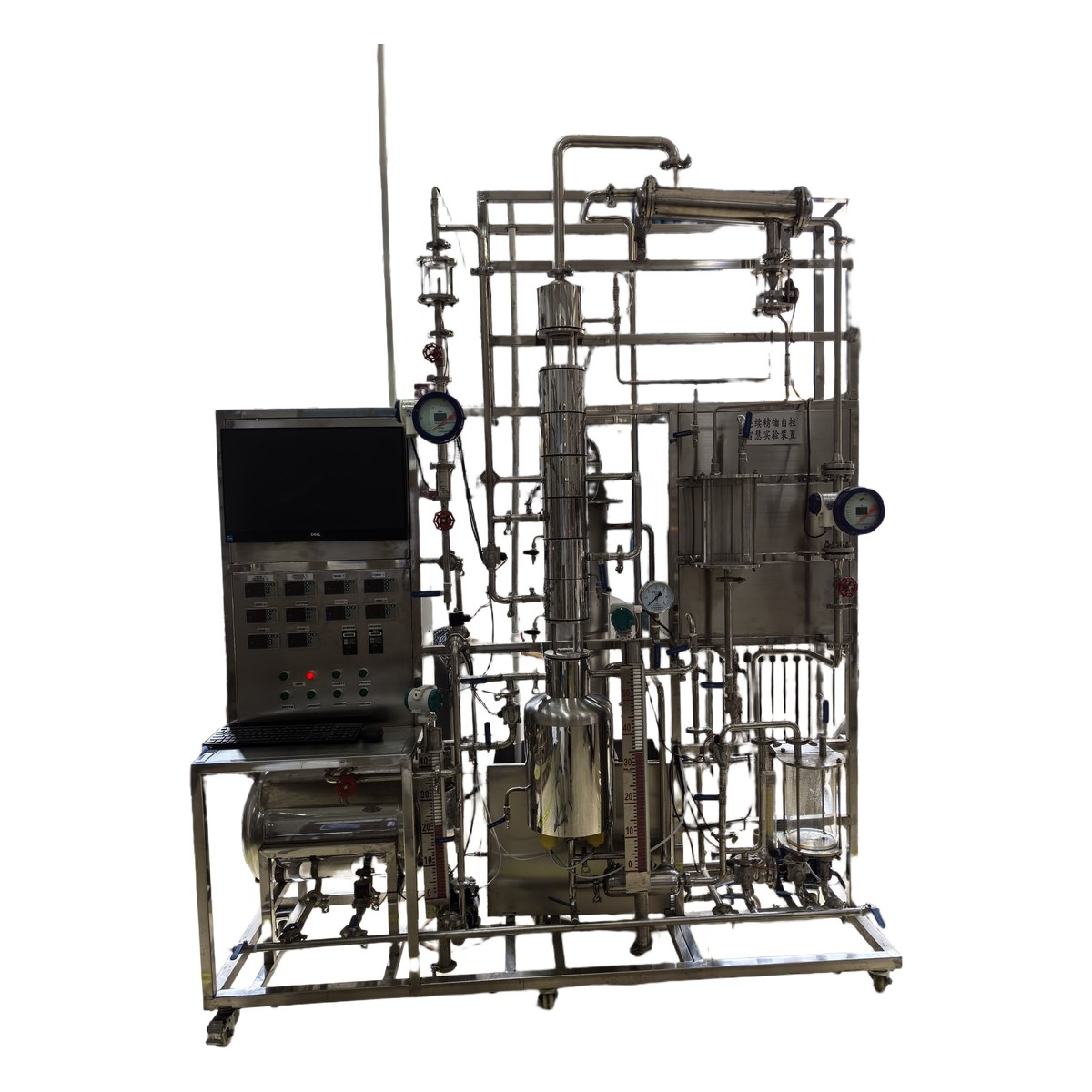
Distillation System Equipment - Product Specification Sheet
1. Product Overview
The distillation system equipment is a complete set of separation units that achieves high-purity separation based on the difference in volatility (or relative volatility) of different components at the same temperature. The entire system comprises the distillation column, reboiler, condenser, reflux system, control unit, and auxiliary equipment, with the main components fabricated from corrosion-resistant stainless steel or carbon steel. It is suitable for organic solvent purification, chemical product separation, solvent recovery, and the refining of fine chemicals. The equipment features high separation accuracy, wide operating flexibility, low energy consumption, stable continuous operation, and a high degree of automated control.
2. Working Principle
After preheating to a set temperature, the feed liquid enters a specific tray or packed section inside the distillation column. The reboiler at the bottom of the column provides rising vapor, while the condenser at the top condenses the vapor into liquid. Part of the condensate is withdrawn as the top product, and the remainder returns to the top as reflux. The rising vapor and downward reflux liquid undergo multiple contacts on the surface of the trays or packing to realize mass and heat transfer. The more volatile components gradually concentrate at the top, and the less volatile components concentrate at the bottom, thus producing products at the top and bottom that meet the required concentration specifications.
3. Structure Types
Batch Distillation: One tower for multiple purposes; suitable for small batch sizes and multi-product separation.
Continuous Distillation: Continuous feed and withdrawal; high efficiency and low energy consumption; suitable for large-scale production.
Tray Column: Equipped with sieve trays, valve trays, or bubble cap trays; suitable for high liquid loads, solids-containing, or easily fouling systems.
Packed Column: Filled with structured or random packing; provides low pressure drop and low liquid holdup; suitable for heat-sensitive materials or separations requiring a high number of theoretical stages.
Extractive Distillation Column: Introduces an extractive solvent to alter the relative volatility; used for close-boiling or azeotropic mixtures.
Reactive Distillation Column: Combines chemical reaction and distillation in one unit, thereby improving conversion and selectivity.
Heat Pump Distillation System: Recovers the latent heat from the top vapor via a heat pump for use in the bottom reboiler, significantly reducing energy consumption.
4. Detailed Technical Parameters
4.1 Main Equipment Common Specifications
Processing Capacity Range: 50 kg/h to 50,000 kg/h; Column Diameter Range: DN200 ~ DN3000 mm; Column Height: 8.0 m ~ 55.0 m (depending on theoretical stages and separation requirements); Operating Pressure: 0.01 MPa (abs) ~ 3.0 MPa; Number of Theoretical Stages: 5 ~ 120; Reflux Ratio Range: 0.5 ~ 20
4.2 Processing Capacity and Equipment Parameter Table
Table
| Model | Capacity (kg/h) | Column Dia. DN (mm) | Column Height (m) | Theo. Stages | Heating Power (kW) | Condensing Area (㎡) | Dimensions L×W×H (m) |
|---|---|---|---|---|---|---|---|
| JR-200 | 200 | 250 | 10.0 | 20 | 30 | 10 | 2.0×1.2×11.5 |
| JR-500 | 500 | 400 | 12.0 | 25 | 60 | 20 | 2.5×1.8×14.0 |
| JR-1000 | 1000 | 600 | 15.0 | 30 | 120 | 40 | 3.2×2.2×17.0 |
| JR-2000 | 2000 | 800 | 18.0 | 35 | 240 | 80 | 3.8×2.8×20.5 |
| JR-5000 | 5000 | 1200 | 25.0 | 40 | 600 | 180 | 5.0×3.5×28.0 |
| JR-10000 | 10000 | 1600 | 32.0 | 45 | 1200 | 350 | 7.0×4.5×35.0 |
Note: Capacity is based on feed flow rate. Structure and parameters can be adjusted according to material properties and separation requirements.
4.3 Design Conditions
Table
| Parameter | Value Range | Remarks |
|---|---|---|
| Design Pressure | -0.1 MPa to 3.0 MPa | Covers vacuum, atmospheric, and pressure distillation |
| Design Temperature | -10°C to 350°C | Determined by allowable material temperature |
| Operating Pressure | Atmospheric / Vacuum (≥0.01 MPa abs) / Pressurized | Selected based on process requirements |
| Column Pressure Drop | ≤ 5 kPa (packed) / ≤ 20 kPa (tray) | Design basis |
| Reflux Ratio | 0.5 ~ 20 | Adjustable during operation |
| Overhead Product Purity | Up to 99.9% as per process needs | Multi-equilibrium stages |
4.4 Core Component Parameters
Table
| Component | Specification/Material | Parameter |
|---|---|---|
| Distillation Column | Structured packing / Trays, SS304/SS316L | Dia. DN200~3000, sectional flange or integral welding |
| Reboiler | Shell and tube / Falling film, SS316L | Heat duty 30~3000 kW |
| Overhead Condenser | Shell and tube / Spiral plate, SS316L | Condensing area 5~500 ㎡ |
| Reflux Drum | Vertical / Horizontal, SS304/SS316L | Volume 20~5000 L |
| Vacuum System | Liquid ring pump + Roots pump set | Ultimate vacuum ≤0.01 MPa |
| Feed Preheater | Shell and tube / Plate, SS316L | Preheats feed to bubble point or set temperature |
| Control System | PLC/HMI, online temperature, pressure, flow | Automatic adjustment of reflux ratio and heating power |
5. Material Selection (International Standard Comparison)
Table
| Component | China GB | ASTM/AISI | DIN EN | Characteristics |
|---|---|---|---|---|
| Column/Internals | S30408 (304) | 304 / S30400 | 1.4301 | General corrosion resistance, suitable for organic solvents, water, weak acids/alkalis |
| Column/Internals | S31603 (316L) | 316L / S31603 | 1.4404 | Contains molybdenum, resists chloride pitting; for chloride-containing & high-purity chemicals |
| Heat Exchanger Tubes | S31603 (316L) | 316L | 1.4404 | High efficiency heat transfer, corrosion resistant |
| Packing (Structured) | S31603 (316L) | 316L | 1.4404 | High specific surface area, low pressure drop |
| Packing (Random) | SS316L / Ceramic / Graphite | 316L / Ceramic / Graphite | 1.4404 / — | Selected based on corrosivity of medium |
| Gaskets | PTFE / Flexible Graphite | PTFE / Graphite | — | Temperature & pressure resistant, excellent chemical compatibility |
| Insulation Jacket | Galv. Steel / SS304 | Galv. Steel / 304 | DX51D / 1.4301 | Protection and thermal insulation |
6. Typical Application Fields
Petrochemicals: Separation of aromatics, alkanes; solvent oil refining; gasoline component separation.
Fine Chemicals: Purification and recovery of organic solvents such as alcohols, ketones, esters, ethers.
Pharmaceuticals: Purification of pharmaceutical intermediates, solvent recovery, separation units in API production.
Food & Flavors: Rectification of edible alcohol, purification of natural flavors, separation of oleochemical products.
Environmental Engineering: Resource recovery and waste reduction of organic solvents from industrial wastewater.
Electronic Chemicals: Refining of high-purity reagents and electronic-grade solvents.
7. Design Standards & Certifications (Internationally Recognized)
Table
| Standard/Certification | Description |
|---|---|
| GB/T 150 / GB/T 151 | China Pressure Vessel Design Code |
| ASME VIII Div.1 | US Pressure Vessel Code (U Stamp optional) |
| PED 2014/68/EU | EU Pressure Equipment Directive (CE Marking) |
| ATEX / IECEx | Explosion-proof certification (optional) |
| GMP | Good Manufacturing Practice (Hygienic/Sanitary design) |
| FDA 21 CFR | Food contact material compliance (optional) |
| ISO 9001:2015 | Quality Management System |
7. Design Standards & Certifications
The equipment is designed, manufactured and inspected in accordance with the following standards and certifications. Applicable codes are confirmed at the technical agreement stage.
| Standard / Certification | Description |
|---|---|
| GB/T 150 / GB/T 151 | Chinese design code for pressure vessels and heat exchangers |
| ASME VIII Div.1 | American pressure vessel code (U-stamp available as an option) |
| PED 2014/68/EU | European Pressure Equipment Directive (CE marking) |
| ATEX / IECEx | Explosion protection certification (optional) |
| GMP | Good Manufacturing Practice, hygienic design for pharmaceutical service |
| FDA 21 CFR | Food-contact material compliance (optional) |
| ISO 9001:2015 | Quality management system |
8. Customization Options
Separation process customization: azeotropic distillation, extractive distillation, reactive distillation, heat pump distillation, etc.
Internals selection: metal structured packing, random packing, valve trays, sieve trays, bubble cap trays.
Heating methods: steam, thermal oil, electric heating, high-temperature high-pressure hot water.
Vacuum degree configuration: simple vacuum, high vacuum distillation, compatible with Roots pumps, diffusion pumps, etc.
Automation level: PLC full automatic control, DCS distributed control system, online component analysis, remote monitoring and data management.
Structural design: skid-mounted mobile type, multi-floor frame type, pass-through cleanroom partition.
Surface finishing: pickling & passivation, mechanical polish, sanitary-grade mirror polish (Ra ≤ 0.4 μm).
Connection standards: HG/T 20592, ASME B16.5, EN 1092, JIS B2220 flanges, or sanitary tri-clamp connections.
Special material requirements: duplex stainless steel, titanium, Hastelloy, Monel, etc.
9. Parameters Required for Ordering
Feed composition and content (mixture components)
Feed flow rate (kg/h or t/d)
Feed state (temperature, pressure, phase)
Required purity or specifications for top and bottom products
Recovery rate or yield requirements
On-site utility conditions (steam pressure, cooling water temperature, electrical capacity, etc.)
Explosion-proof and safety requirements
Target certifications or codes (ASME/PED/GB/GMP, etc.)
Space constraints and installation environment