Alcohol Recovery Tower
Extraction & Distillation
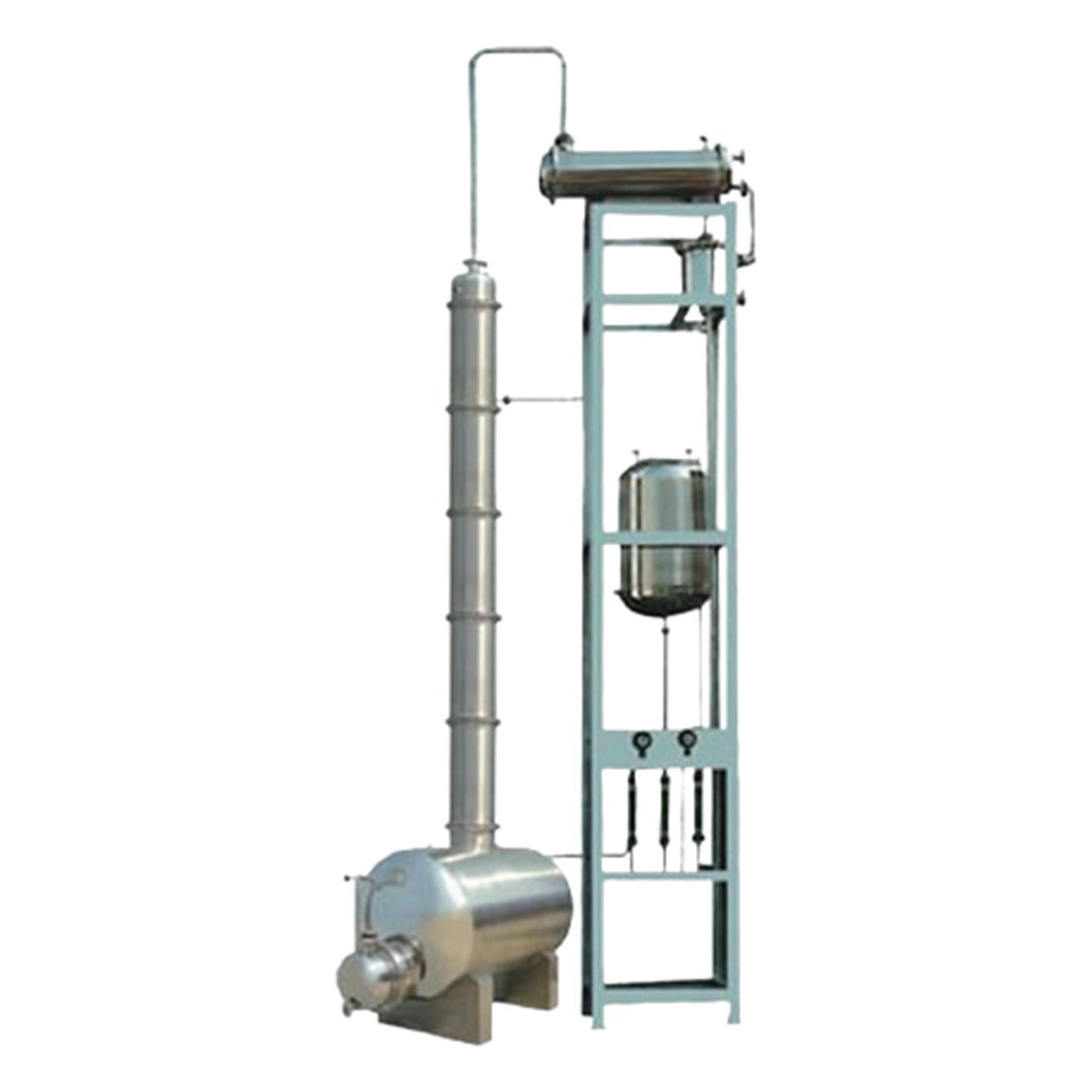
Alcohol Recovery Tower - Product Specification Sheet
1. Product Overview
The Alcohol Recovery Tower is a high-efficiency separation and purification device based on the distillation principle, specifically designed to recover and refine high-concentration alcohol from dilute alcohol solutions. This complete system integrates preheating, distillation, condensation, reflux, and automatic control units, with a main body fabricated from corrosion-resistant stainless steel. Distinguished by high separation efficiency, wide operational flexibility, stable performance, and long service life, it effectively lowers organic solvent procurement costs and minimizes liquid waste discharge.
2. Working Principle
The system operates using the significant difference in volatility (vapor pressure) between alcohol, water, and other volatile components at equivalent temperature. Dilute alcohol feed is preheated and introduced into the tower's reboiler, where it is vaporized. The resulting mixed vapor ascends through high-efficiency structured packing or trays within the column, engaging in multiple counter-current, vapor-liquid contacts with condensed reflux liquid returning from the top along the packing surface to achieve mass and heat transfer. High-concentration alcohol vapor is subsequently fully condensed in the overhead condenser: one portion is extracted as the product, while the remainder flows back into the column as reflux to maintain the required concentration gradient and operating purity.
3. Structure Types
Batch Distillation Tower: Simple structure, flexible operation, suited for small-batch, multi-solvent recovery.
Continuous Distillation Tower: Stable continuous feed and discharge, energy-efficient, suited for large-scale single-solvent production.
Structured Packing Tower: Utilizes stainless steel corrugated structured packing, providing high efficiency and low pressure drop.
Plate Tower: Suitable for feeds containing solid particles or possessing high viscosity, with strong anti-fouling capabilities.
Vacuum Distillation Tower: Lowers operational boiling point, designed for heat-sensitive or easy-to-decompose materials.
4. Detailed Technical Parameters
Main Equipment Common Specifications and Capacities
Column Diameter Range: DN150 ~ DN1200 mmColumn Height: 6.0 ~ 18.0 m (customized for specific separation requirements)Processing Capacity: 50 L/h to 5000 L/h feed flow rateProduct Concentration: 90% ~ 95%vol (adjustable within the range as per process needs)
Processing Capacity and Equipment Parameter Table
Table
| Model | Capacity (L/h) | Feed Conc. (%vol) | Output Conc. (%vol) | Column Dia. (mm) | Column Height (m) | Steam Cons. (kg/h) | Cooling Area (㎡) | Dimensions L×W×H (m) |
|---|---|---|---|---|---|---|---|---|
| JT-100 | 100 | 30~50 | ≥95 | 200 | 7.5 | 60 | 6.0 | 1.2×0.8×8.5 |
| JT-200 | 200 | 30~50 | ≥95 | 300 | 9.0 | 120 | 10.0 | 1.4×1.0×10.0 |
| JT-500 | 500 | 30~50 | ≥95 | 450 | 11.0 | 280 | 22.0 | 1.8×1.5×12.5 |
| JT-1000 | 1000 | 30~50 | ≥95 | 600 | 13.0 | 550 | 40.0 | 2.2×1.8×14.5 |
| JT-2000 | 2000 | 30~50 | ≥95 | 800 | 15.0 | 1100 | 80.0 | 2.8×2.2×16.5 |
Note: Larger capacities available. Steam consumption calculated based on 0.3 MPa saturated steam.
Design Conditions
Table
| Parameter | Value Range | Remarks |
|---|---|---|
| Design Pressure | -0.1 MPa to 0.5 MPa | Higher rating available |
| Design Temperature | -10°C to 200°C | Determined by heating medium |
| System Leak Rate | ≤ 0.1% / 24h | Static air-tightness test standard |
| Top Vacuum Level | Up to -0.098 MPa | For vacuum distillation configuration |
| Explosion-proof Class | ExdIIBT4 / ExdIIBT6 | Suitable for Zone 1 areas |
Core Internals Packing Specifications
Table
| Packing Type | Material | Surface Area (㎡/m³) | HETP (mm) | Suitable For |
|---|---|---|---|---|
| Structured Packing 250Y | SS304 / SS316L | 250 | 280~400 | General purpose, high efficiency, low resistance |
| Structured Packing 500Y | SS316L | 500 | 150~250 | High precision, high concentration requirements |
| Random Pall Ring | SS316L | 120~250 | 400~800 | Solids-containing / fouling prone feeds |
| Ceramic Raschig Ring | Alumina Ceramic | 90~150 | 500~1000 | Highly acidic or corrosive media |
5. Material Selection (International Standard Comparison)
Table
| Component | China GB | ASTM/AISI | DIN EN | Characteristics |
|---|---|---|---|---|
| Column Body / Reboiler | S30408 (304) | 304 / S30400 | 1.4301 | Quality corrosion resistance, suitable for water, organic solvents, food grade |
| Column Body / Reboiler | S31603 (316L) | 316L / S31603 | 1.4404 | Molybdenum-bearing, resists chloride pitting; high purity/chlorinated systems |
| Condenser Tubes | S31603 (316L) | 316L | 1.4404 | Efficient heat transfer, corrosion resistant, low fouling |
| Structured Packing | S31603 (316L) | 316L | 1.4404 | High surface area, low pressure drop |
| Gaskets | PTFE | PTFE | — | Excellent chemical compatibility, reliable sealing |
| Insulation Jacket | Galv. Steel / SS304 | Galv. Steel / 304 | DX51D / 1.4301 | Protection and thermal insulation |
6. Typical Application Fields (Global Major Industries)
Pharmaceutical Industry: Alcohol recovery from antibiotic, vitamin, and herbal extraction; API synthesis solvent recovery.
Food & Beverage: Fruit wine distillation; base spirit deodorization; edible alcohol and spirits rectification.
Fine Chemicals: Organic solvent recovery (methanol, acetone, ethyl acetate); turpentine and dipentene separation.
Bioengineering: Bio-ethanol concentration and recovery; solvent extraction from fermentation mashes.
Environmental Engineering: Resource recovery of alcohol solvents from industrial wastewater; waste volume reduction.
New Energy: Dehydration and purification of fuel ethanol.
7. Design Standards & Certifications (Internationally Recognized)
Table
| Standard / Certification | Description |
|---|---|
| GB/T 150 / GB/T 151 | China Pressure Vessel Design Code |
| ASME VIII Div.1 | US Pressure Vessel Code (U Stamp optional) |
| PED 2014/68/EU | EU Pressure Equipment Directive (CE Marking) |
| GMP | Good Manufacturing Practice (Clean and hygienic design) |
| EAC / CU-TR | Eurasian Conformity Mark (Customs Union market access) |
| ISO 9001:2015 | Quality Management System |
7. Design Standards & Certifications
The equipment is designed, manufactured and inspected in accordance with the following standards and certifications. Applicable codes are confirmed at the technical agreement stage.
| Standard / Certification | Description |
|---|---|
| GB/T 150 / GB/T 151 | Chinese design code for pressure vessels and heat exchangers |
| ASME VIII Div.1 | American pressure vessel code (U-stamp available as an option) |
| PED 2014/68/EU | European Pressure Equipment Directive (CE marking) |
| ATEX / IECEx | Explosion protection certification (optional) |
| GMP | Good Manufacturing Practice, hygienic design for pharmaceutical service |
| FDA 21 CFR | Food-contact material compliance (optional) |
| ISO 9001:2015 | Quality management system |
8. Customization Options
Energy-saving configurations: Dual-effect, triple-effect differential pressure distillation, significantly reducing steam consumption.
Heating types: Steam heating, thermal oil heating, electric heating modules.
Automation upgrades: PLC fully automatic control, online real-time concentration monitoring, HMI touchscreen.
Cleaning & Sterilization: CIP (Clean-in-Place) systems, SIP (Sterilize-in-Place) functionality.
Structural forms: Skid-mounted mobile integrated systems; pass-through cleanroom partition installation.
Surface finishing: Pickling and passivation, sanitary grade mirror polishing (Ra ≤ 0.4 μm).
Connection standards: ANSI B16.5, DIN 2633, JIS flanges, or sanitary tri-clamp connections.
9. Parameters Required for Ordering
Feedstock name and primary component composition
Feed flow rate (ton/day or L/h)
Feed alcohol concentration (%vol)
Required product alcohol concentration (%vol)
Available on-site heat source (steam pressure / thermal oil parameters / power capacity)
Cooling water inlet temperature and supply conditions
Installation site environment (indoor/outdoor, explosion-proof class and certification requirements)