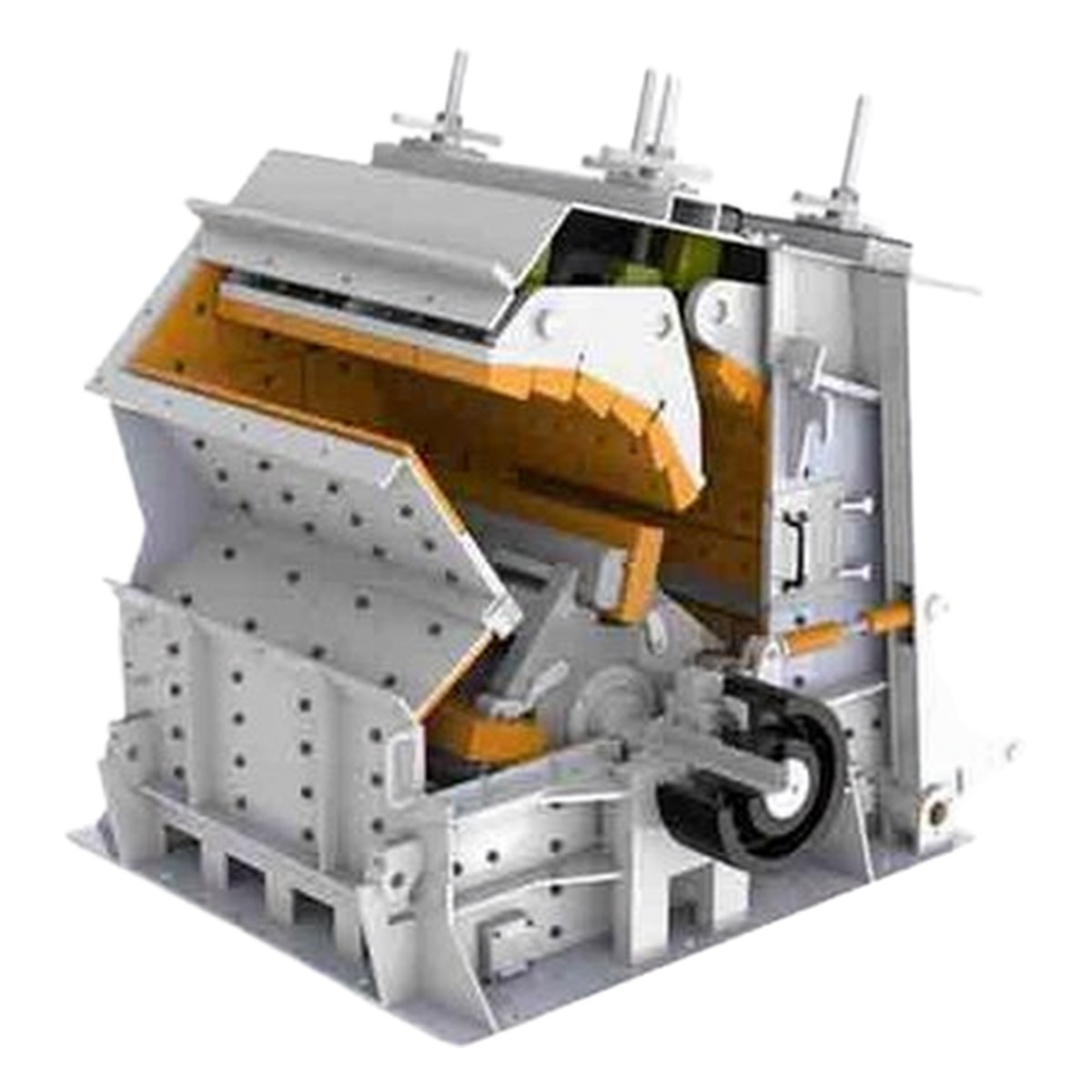
Impact Crusher
1. Product Overview
1.1 General Description
The impact crusher is a machine for further reducing medium-sized material to fine sizes (2-25 mm) in secondary and tertiary crushing. The commonly used impact crusher breaks material by the impact of blow bars mounted on a high-speed rotor; material struck by the blow bars is thrown against the impact plates and broken again, reaching the required size after repeated impacts. The impact crusher offers a large crushing ratio (up to 50), good product shape (high cubical content) and a simple structure, and is widely used for secondary and tertiary crushing in the building material, mining, highway and railway industries.
1.2 Key Features
- Crushing ratio up to 50
- Good product shape with cubical content ≥85%
- Simple structure and easy maintenance
- Blow bars can be turned over when worn
- Multi-chamber design suits different materials
- Hydraulic housing opening for easy inspection
- Adjustable discharge opening
- High capacity and low energy consumption
1.3 Document Scope
This technical specification covers the design principles, performance parameters, system classification, selection of core components, application fields, design standards and certifications, custom optional configurations, warranty terms, packaging and delivery, and the information required for inquiries of the impact crusher, serving as a comprehensive reference for procurement selection and engineering communication.
2. Working Principle
2.1 Impact Crusher Process Flow
Impact crusher process flow: material enters the crushing chamber → high-speed impact from the blow bars → material is thrown against the impact plates → broken again on impact → rebounds and is struck by the blow bars again → required size reached after repeated impacts → discharged from the outlet. The rotor rotates at high speed (tip speed 30-50 m/s), and the blow bars accelerate the material and throw it against the impact plates. The impact plates are fitted with toothed or curved liners; after impact the material is broken again and deflected back into the path of the rotating blow bars to be struck once more. The discharge size is controlled by adjusting the gap between the impact plates and the rotor.
3. System Classification
| Classification | Typical models | Parameter range | Applications | Key features |
|---|
| Small | PF-0807, PF-1008 | Rotor diameter 800-1000 mm | Small-scale production | 3 blow bars |
| Medium | PF-1210, PF-1315 | Rotor diameter 1200-1300 mm | Regular production | 4-6 blow bars |
| Large | PF-1520, PF-1820 | Rotor diameter 1500-1800 mm | Large-scale production | 6-8 blow bars |
4. Technical Parameters
4.1 Main Technical Parameters of the Impact Crusher
| Parameter | PF-0807 | PF-1008 | PF-1210 | PF-1315 | PF-1520 | PF-1820 |
|---|
| Rotor diameter × length (mm) | 800×700 | 1000×800 | 1200×1000 | 1300×1500 | 1500×2000 | 1800×2000 |
| Max. feed size (mm) | 120 | 180 | 250 | 300 | 400 | 500 |
| Discharge size (mm) | 5-25 | 5-30 | 5-35 | 5-40 | 5-45 | 5-50 |
| Capacity (t/h) | 15-30 | 30-60 | 60-120 | 100-200 | 180-350 | 250-500 |
| Motor power (kW) | 30 | 55 | 110 | 200 | 315 | 500 |
| Number of blow bars | 3 | 3 | 4 | 6 | 6 | 8 |
| Weight (kg) | 5000 | 9000 | 16000 | 26000 | 40000 | 60000 |
4.2 Dimensions and Weight
| Model | Length (mm) | Width (mm) | Height (mm) | Net weight (kg) | Footprint (m²) |
|---|
| PF-0807 | 1800 | 1500 | 1800 | 5000 | 2.7 |
| PF-1008 | 2200 | 1800 | 2000 | 9000 | 4.0 |
| PF-1210 | 2600 | 2200 | 2500 | 16000 | 5.7 |
| PF-1315 | 3000 | 2600 | 2900 | 26000 | 7.8 |
| PF-1520 | 3600 | 3000 | 3200 | 40000 | 10.8 |
| PF-1820 | 4200 | 3500 | 3800 | 60000 | 14.7 |
5. Applications
| Application field | Typical materials | Special requirements | Representative products |
|---|
| Building materials | Limestone/sandstone/gypsum | Good particle shape | Construction aggregate |
| Highway | Basalt/andesite | Cubical particle shape | Pavement aggregate |
| Mining | Iron ore/copper ore | Secondary and tertiary crushing | Fine crushing of metal ores |
| Chemical | Salt/soda ash/fertilizer | Corrosion resistance | Industrial salt crushing |
| Power | Coal/gangue | High capacity | Fine coal crushing |
6. Core Component Selection
| Component | Function | Material | Selection notes |
|---|
| Blow bar | Impacts and crushes the material | High-chrome cast iron/alloy steel | Can be turned over when worn |
| Impact plate | Rebounds material for secondary crushing | High-manganese steel/alloy steel | Adjustable gap controls the size |
| Rotor | Drives the blow bars | Cast steel/welded | Dynamic balancing required |
| Housing | Contains the material | Welded steel plate | Wear-resistant liner inside |
| Main bearings | Support the rotor | Double-row spherical roller | Regular lubrication required |
| Hydraulic system | Housing opening and adjustment | Hydraulic cylinders + power pack | Easy maintenance |
| Transmission | Transmits power | Pulley | Overload protection required |
| Adjustment device | Adjusts the impact plate gap | Hydraulic/spring | Controls the discharge size |
7. Design Standards and Certifications
| Standard/Certification | Scope | Compliance | Certificate/Report |
|---|
| Relevant GB/T standards | Design and manufacture | Fully compliant | Type inspection report |
| GMP (cGMP) | Design, manufacture, documentation | Fully compliant | GMP compliance certificate |
| ISO 9001:2015 | Quality management system | Certified | ISO 9001 certificate |
| CE certification | Machinery safety/EMC | Optional | CE declaration of conformity |
| FDA | Food-grade/pharmaceutical-grade | Optional | FDA compliance documents |
8. Custom Optional Configurations
| No. | Custom item | Options | Default | Impact on delivery |
|---|
| 1 | Blow bar material | High-chrome cast iron/alloy steel/ceramics | High-chrome cast iron | Alloy +2 weeks |
| 2 | Impact plates | Single-stage/two-stage/three-stage | Two-stage | Three-stage +2 weeks |
| 3 | Housing opening | Manual/hydraulic | Manual | Hydraulic +1 week |
| 4 | Motor brand | Domestic/ABB/Siemens | Domestic | Imported +2 weeks |
9. Material Property Requirements
| Material characteristic | Requirement | Remarks |
|---|
| Working temperature | -40~250℃ | Depends on the seals and materials |
| Corrosiveness | Mild to moderate corrosion | 316L or lining required for strong corrosion |
| Explosion protection | Selected according to the site | Zone1/Zone2 different levels |
10. Warranty Terms
| Warranty category | Period | Coverage | Conditions |
|---|
| Main equipment warranty | 12 months | All components included | 12 months from successful commissioning |
| Extended warranty (optional) | 24 months | Same as the standard warranty | Must be purchased with the order |
| Wear parts warranty | 6 months | Seals, bearings, etc. | Normal wear excluded |
11. Packaging and Delivery
| Item | Details |
|---|
| Standard lead time | 6-10 weeks after order confirmation |
| Custom configuration lead time | 10-16 weeks |
| Incoterms | FOB Shanghai / CIF / DAP |
| Packing | Export wooden case |
| Shipping | Container or break-bulk vessel |
12. Information Required for Inquiry
| No. | Information required | Description/Example |
|---|
| 1 | Material name and hardness | Mohs hardness/compressive strength |
| 2 | Max. feed size | mm |
| 3 | Discharge size | mm |
| 4 | Capacity required | t/h |
| 5 | Particle shape requirement | Flakiness content % |
| 6 | Moisture content | % |
| 7 | Working environment | Indoor/outdoor |
| 8 | Power supply specification | V/Hz/kW |