Spiral Plate Exchanger
Heat Exchangers
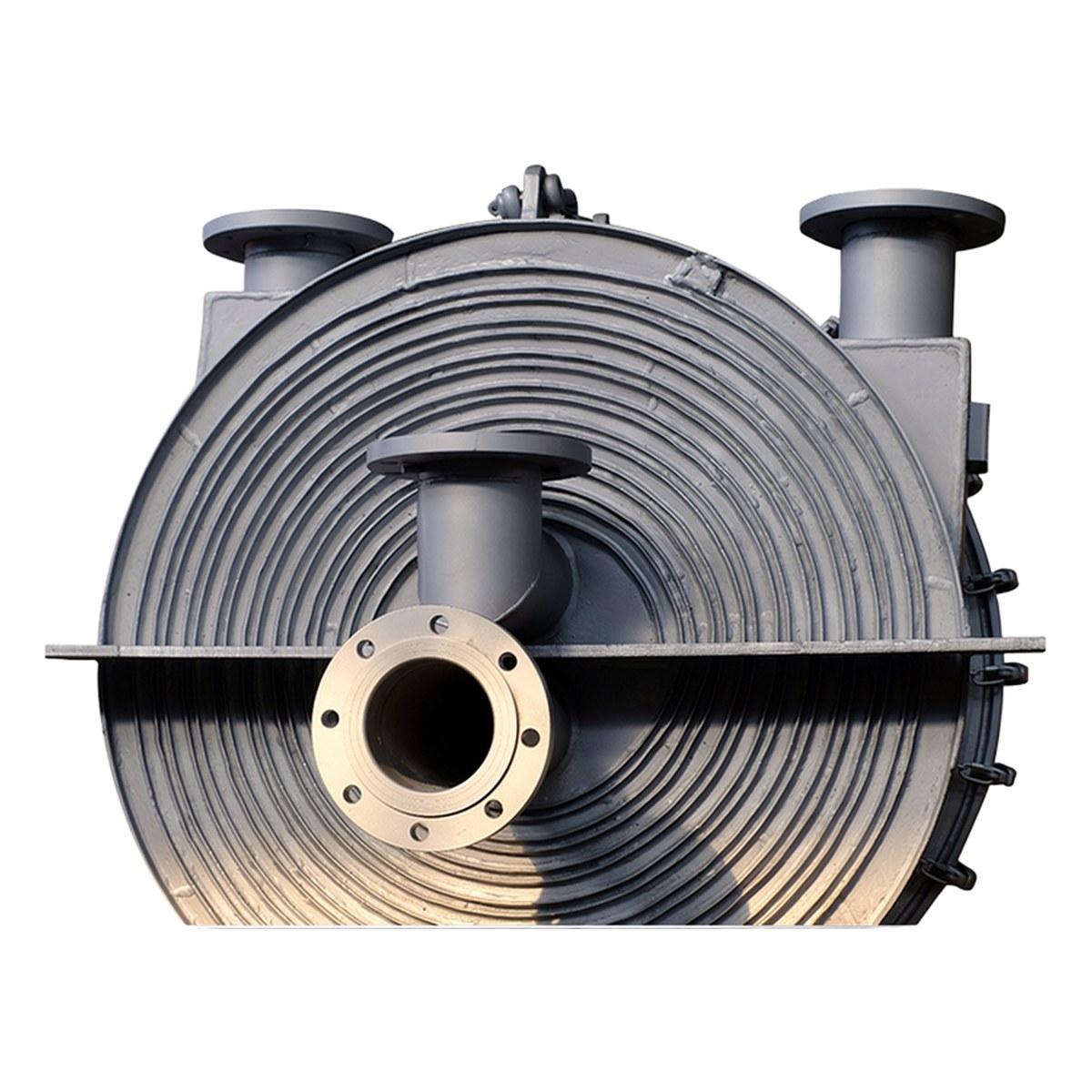
Spiral Plate Heat Exchanger
1. Product Overview
A spiral plate heat exchanger is a compact heat exchanger made by rolling two parallel metal plates into two spiral channels, with the hot and cold fluids flowing counter-currently through the two channels to transfer heat. It consists of the spiral plate body, end covers, inlet/outlet nozzles and supports. There are no contact points inside the channels, so the fluid maintains a uniform flow velocity.
Widely used for heating and cooling of chemical process fluids, concentration and heat exchange of pharmaceutical liquids, heating and cooling of food products, and heat exchange in HVAC district heating, among other applications.
Equipment features: compact structure with a large heat transfer area per unit; self-cleaning effect of the spiral channels; relatively low fluid resistance; lower cost than a gasketed plate heat exchanger of equal area. Note that in the non-removable type the channels cannot be cleaned internally, and internal leakage cannot be repaired.
2. Working Principle
Spacing studs are welded between the two metal plates, which are then rolled into a spiral body, forming two completely separate spiral channels on either side of the plates. The hot fluid enters the spiral channel through a nozzle on one side, and the cold fluid enters the adjacent channel through a nozzle on the other side; the two fluids flow in strict counter-current through the channels. The centrifugal force in the spiral channels generates secondary circulation that enhances turbulence while providing a self-cleaning effect, effectively reducing scaling and clogging. Heat is transferred from the hot side to the cold side through the metal plates.
3. System Classification
By Structural Form
| Type | Features | Application |
|---|---|---|
| Non-removable (most common) | Spiral body welded sealed, end covers removable, channels cannot be cleaned | Most applications, clean fluids or low scaling tendency |
| Removable | Spiral body can be opened, channels can be cleaned | Dirtier fluids requiring periodic cleaning |
By Channel Type
| Type | Features | Application |
|---|---|---|
| Both sides spiral channels | Standard spiral plate heat exchanger | Conventional liquid-liquid heat exchange |
| One spiral + one straight channel | Spiral channel on one side, straight half-pipe channel on the other | High flow rate on one side or gas-liquid separation needed (e.g., condensation duty) |
By Plate Material
| Type | Features | Application |
|---|---|---|
| Carbon steel | Low cost | Non-corrosive media |
| Stainless steel | Corrosion resistant | General corrosive media |
| Duplex steel | Pitting corrosion resistant | Chloride-containing media |
| Titanium | Strong corrosion resistance | Strongly corrosive media (HCl, wet chlorine) |
4. Detailed Technical Parameters
4.1 Common Plate Materials and Applications
| Material | Grade | Applicable Media | Remarks |
|---|---|---|---|
| Carbon steel | Q235B/Q345R | Non-corrosive cooling water, non-corrosive process fluid | Lowest cost |
| 304 stainless steel | 0Cr18Ni9 | Weakly corrosive media, general chemical processes | Standard configuration, good value for money |
| 316L stainless steel | 00Cr17Ni14Mo2 | Chloride-containing media, acetic acid, pharmaceutical | Recommended first choice, excellent corrosion resistance |
| 2205 duplex steel | 00Cr22Ni5Mo3N | Chloride-containing media, high stress environments | Good long-term corrosion resistance |
| Titanium | TA2 | Strongly corrosive media (HCl, wet chlorine) | High cost, selected as needed |
4.2 Typical Specification Table
| Heat Exchange Area (m²) | Plate Width (mm) | Spiral Body Dia. (mm) | Plate Thickness (mm) | Channel Gap (mm) | Design Pressure (MPa) | Design Temp (°C) | |-------------------------|------------------|---------------------|-------------------|-------------------|-------------------:| | 3~6 | 200~300 | 400~500 | 2~4 | 6~14 | 0.6~1.6 | -20~250 | | 6~15 | 300~500 | 500~700 | 3~4 | 10~20 | 0.6~1.6 | -20~250 | | 15~30 | 400~600 | 700~900 | 4~6 | 14~24 | 0.6~1.6 | -20~250 | | 30~60 | 500~800 | 900~1200 | 4~6 | 18~28 | 0.6~1.6 | -20~250 | | 60~120 | 600~1000 | 1200~1600 | 4~6 | 20~30 | 0.6~1.6 | -20~250 | | 120~200 | 800~1400 | 1600~2000 | 6~8 | 22~32 | 0.6~1.6 | -20~250 |
Note: Actual specifications are adjusted according to channel gap, plate thickness, pressure class and other factors; customization is available on request. Plate width typically ranges from 200 to 1500 mm; wider plates are limited by the capacity of the rolling equipment.
4.3 Design Conditions & Performance Indicators
| Parameter | Specification |
|---|---|
| Design pressure range | 0.6~1.6MPa (higher negotiable) |
| Design temperature range | -20°C~350°C (material dependent) |
| Overall heat transfer coefficient (typical) | 500~3000 W/(m²·K) (higher than shell-and-tube, lower than PHE) |
| Spiral channel flow velocity | 0.5~3.0 m/s (determined by media and allowable pressure drop) |
| Single-channel pressure drop | Determined by allowable process pressure drop |
| Number of channels | Typically 2, special designs can be 3 channels |
| Welding process | Distance pillar spot welding + edge arc welding + channel seal welding |
| Surface treatment | Anti-rust paint on outer wall, optional insulation |
4.4 Electrical Parameters
Standard spiral plate heat exchanger has no electrical requirements.
5. Core Component Selection
| Component | Common Brands | Features & Application |
|---|---|---|
| Spiral body | Quality domestic brands (steel plates procured by material requirements) | Plate quality and rolling precision determine equipment quality |
| End covers | Quality domestic brands | Cast iron or carbon steel end covers, determined by pressure class |
| Nozzle flanges | Quality domestic brands | Per HG/T 20592 standard or customer requirements |
| Sealing gaskets | Quality domestic brands | Asbestos rubber gaskets, PTFE gaskets, selected by media and temperature |
| Supports | Quality domestic brands | Leg support / Saddle support |
Customer brand preferences can be specified. For pre-owned equipment, availability depends on inventory.
6. Typical Application Fields
Chemical industry: Process fluid heating and cooling, wastewater heat exchange, solvent recovery heat exchange
Pharmaceutical industry: Liquid concentration heat exchange, purified water system heat exchange
Food industry: Material heating and cooling, juice concentration heat exchange
HVAC: District heating heat exchange stations, air conditioning system heat exchange
Light industry: Pulp and paper industry slurry heating/cooling, printing and dyeing industry dye solution heat exchange
Environmental: Exhaust gas treatment heat exchange, wastewater treatment heat exchange
7. Design Standards & Certifications
| Standard | Description |
|---|---|
| GB/T 28712.2-2022 | Spiral plate heat exchangers (China) |
| JB/T 4723-1992 | Technical conditions for spiral plate heat exchangers (China) |
| GB/T 150-2011 | Pressure vessels (applicable to end covers when pressurized) |
| ISO 9001:2015 | Quality management system |
| CE | Available upon request for international orders (PED 2014/68/EU) |
| EAC | Available upon request for Russia and Central Asia markets |
| GOST-R | Available upon request for Russian market |
8. Customizable Options
| Option | Details |
|---|---|
| Structural form | Non-removable / Removable |
| Plate material | Carbon steel / 304 / 316L / 2205 duplex / Titanium |
| Channel type | Dual spiral channels / Spiral + straight channel |
| Channel gap | Determined by process calculation (affects area and pressure drop) |
| Plate width and thickness | Determined by area and pressure requirements |
| End cover type | Cast iron / Carbon steel / Stainless steel |
| Nozzle specifications | Matched to process piping |
| Insulation | Rock wool / aluminum silicate insulation + stainless steel or color steel cladding |
| Anti-corrosion coating | Internal anti-corrosion coating on end covers (for special conditions) |
9. Warranty Terms
| Equipment Status | Warranty Period | Warranty Scope |
|---|---|---|
| New equipment | 12 months | Spiral body, end covers, nozzles, sealing gaskets, supports |
| Refurbished equipment | 6 months | Spiral body, end covers, nozzles, sealing gaskets, supports |
| Pre-owned equipment (as-is supply) | 3 months | Main functional components |
Spiral plate special note: The biggest risk of spiral plate heat exchangers is internal leakage between channels. Once internal leakage occurs, it cannot be repaired and the entire unit is scrapped. Natural corrosion thinning during normal use within the warranty period is not covered. Internal leakage caused by overpressure use or incorrect media selection resulting in corrosion perforation is not covered.
Final warranty terms are subject to contract. All orders include installation guidance and remote commissioning support.
10. Packaging & Delivery
| Item | Packaging Method |
|---|---|
| Complete spiral plate heat exchanger | Bare packaging with steel band fixation, nozzle caps, end cover flange protection |
| Spare gaskets | Waterproof sealed packaging in carton |
| Small accessories | Carton or wooden box packaging |
Container capacity estimate (for reference only, subject to actual configuration):
Below 10m² small units: approximately 3-6 units per 20'GP container
10~30m² medium: approximately 1-3 units per 20'GP
30~60m² large: approximately 1-2 units per 40'HQ container
Above 60m² extra-large: bulk vessel or flat rack container
Installation service: on-site installation guidance is available. Pay attention to correct nozzle orientation and even bolt tightening after the gaskets are seated. Technicians can be dispatched to site for large equipment (travel and accommodation expenses borne by the buyer).
11. Information Required for Quotation
To obtain an accurate quotation, please provide the following information:
Hot fluid: name, inlet/outlet temperature, flow rate or heat load
Cold fluid: name, inlet/outlet temperature, flow rate or heat load
Working pressure and allowable pressure drop on both sides
Media corrosiveness on both sides, and whether solid particles are present (spiral plate heat exchangers are not suitable for media containing solid particles)
Plate material preference; structural form preference: non-removable / removable; whether one straight channel is needed (e.g., for condensation duty); channel gap preference (if unknown, we can calculate it based on your process conditions); nozzle specifications
Whether insulation needed
Equipment status preference: New / Refurbished / Pre-owned
Budget range and brand preference (if any)
Delivery terms: FOB/CIF/DDP
Destination port or delivery address (for freight calculation)