Short-path Molecular Distillation
Extraction & Distillation
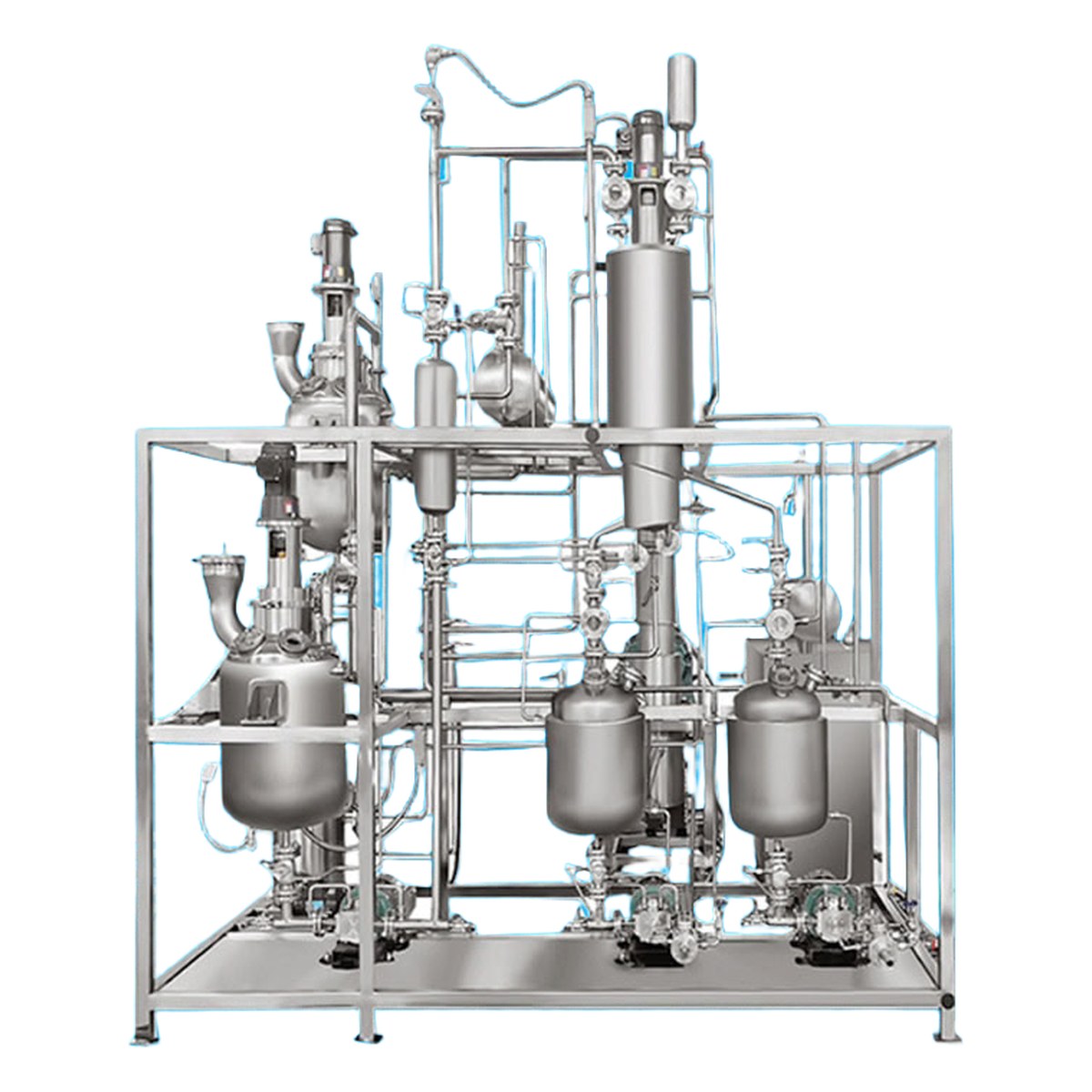
Short Path Molecular Distillation - Product Specification Sheet
1. Product Overview
Short Path Molecular Distillation (also referred to as short-path distillation or molecular distillation) is a specialized high-vacuum liquid-liquid separation technology that achieves separation based on the difference in the mean free path of molecular motion of different substances under extremely high vacuum conditions. Its core feature is the extremely short distance between the evaporation surface and the condensation surface, allowing light fraction molecules to quickly reach the condenser and be captured after evaporation, while heavy fraction molecules are unable to reach the condenser due to their shorter mean free path and subsequently flow downward along the evaporation surface for discharge. This equipment is particularly suitable for the separation and purification of high-boiling-point, heat-sensitive, and easily oxidized materials. It is widely used in pharmaceuticals, food, fine chemicals, environmental protection, and other fields.
2. Working Principle
Short Path Molecular Distillation utilizes the difference in the mean free path of light and heavy component molecules escaping from the liquid phase to achieve separation. Under high vacuum conditions, the material flows downward in the form of a liquid thin film along the inner wall of the evaporator, with a rotating wiper system ensuring that the film is extremely thin and uniformly distributed. After evaporation, light fraction molecules can quickly condense on the internal condenser because the distance between the evaporation surface and the internal condensation surface is extremely short (less than the mean free path of the light fraction molecules). Heavy fraction molecules are unable to reach the condenser due to their shorter mean free path and are discharged along the evaporation surface, thus achieving directional separation. Because the operating temperature is far below the boiling point of the material and the heating time is only a few seconds to tens of seconds, the activity of heat-sensitive materials is maximally preserved.
3. Structure Types
Wiped-Film Molecular Still: Uses PTFE or SS316L stainless steel rotating wipers to forcibly form a uniform thin film (<1 mm), offering high separation efficiency; currently the mainstream design.
Falling-Film Molecular Still: Relies on gravity to form the film; simple structure but thicker film, low separation efficiency; rarely used today.
Centrifugal Molecular Still: Uses centrifugal force to form the film; thin film and high evaporation efficiency, but complex structure, difficult vacuum sealing, and high manufacturing costs.
Glass Molecular Distillation System: Main body made of high borosilicate 3.3 glass, fully transparent and visible; suitable for benchtop experiments and process development.
Stainless Steel Molecular Distillation System: Full 316L stainless steel structure, high strength and resistant to high temperature and pressure; suitable for pilot and industrial continuous production.
Hybrid Still: Combines the functionality of a wiped-film evaporator with a packed fractionation column; suitable for separating heat-sensitive compounds with close boiling points.
4. Detailed Technical Parameters
4.1 Main Equipment Common Specifications
Evaporation Area Range: 0.05 m² ~ 50 m²Processing Capacity Range: 0.1 L/h ~ several tons/hourOperating Vacuum: 0.001 mbar ~ 10 PaOperating Temperature: ambient ~ 350°C (stainless steel type up to 350°C)Film Thickness: <0.5 mm
4.2 Technical Parameter Table
| Model | Evap. Area (m²) | Cond. Area (m²) | Inner Dia. (mm) | Flow Rate (L/h) | Speed (r/min) | Motor Power (W) | Heating Temp. (°C) | Vacuum (Pa) | Dimensions L×W×H (mm) |
|---|---|---|---|---|---|---|---|---|---|
| FMD-60(A) | 0.05 | 0.10 | 60 | 0.1~2.0 | 0~450 | 120 | R.T.~200 | ≤10 | 1500×600×1800 |
| FMD-80(A) | 0.10 | 0.15 | 80 | 0.3~4.0 | 0~450 | 120 | R.T.~200 | ≤10 | 1600×650×1900 |
| FMD-100(A) | 0.15 | 0.20 | 100 | 0.5~5.0 | 0~450 | 120 | R.T.~200 | ≤10 | 1700×700×2000 |
| FMD-150(A) | 0.25 | 0.40 | 150 | 1.0~8.0 | 0~450 | 120 | R.T.~200 | ≤10 | 1800×750×2100 |
| FMD-200(A) | 0.35 | 0.50 | 190 | 1.5~10.0 | 0~450 | 200 | R.T.~200 | ≤10 | 1900×800×2200 |
| FMD-230(A) | 0.50 | 0.65 | 220 | 2.0~15.0 | 0~300 | 200 | R.T.~200 | ≤10 | 2100×850×2300 |
4.3 Design Conditions
| Parameter | Value Range | Remarks |
|---|---|---|
| Design Pressure | -0.1 MPa (absolute pressure 1~10 Pa) | High vacuum condition |
| Design Temperature | R.T. ~ 350°C | Stainless steel up to 350°C |
| System Ultimate Vacuum | 0.001 mbar (0.1 Pa) | Rotary vane pump + diffusion pump |
| Film Thickness | <0.5 mm | Wiper forced film formation |
| Residence Time | seconds to tens of seconds | Much shorter than traditional distillation |
| Evap.-Cond. Distance | <10 cm | Short path design |
4.4 Core Component Parameters
| Component | Material/Specification | Parameter |
|---|---|---|
| Wiped-film System | PTFE / SS316L rotating wipers | Film thickness < 0.5 mm |
| Evaporator | Borosilicate 3.3 glass / 316L SS | Jacketed heating |
| Internal Condenser | Borosilicate glass / 316L SS | Integrated with evaporator |
| Vacuum System | Rotary vane pump + oil diffusion pump | Ultimate vacuum 0.001 mbar |
| Seal System | Magnetic coupling / FKM / PTFE-encapsulated | High vacuum maintenance |
| Feeding System | Gear pump / metering pump | Adjustable feed rate |
5. Material Selection (International Standard Comparison)
| Component | Material | Grade | Characteristics |
|---|---|---|---|
| Evaporator Body (Glass) | Borosilicate glass 3.3 | — | Transparent and visible, corrosion resistant, high chemical stability, lower mechanical strength |
| Evaporator Body (SS) | 316L Stainless Steel | S31603 / 1.4404 | High strength, high temp. & pressure resistant, suitable for industrial production |
| Wiper Blade | PTFE (Polytetrafluoroethylene) | — | Anti-adhesion, chemical resistant, suitable for high-viscosity materials |
| Wiper Blade (High-Temp) | Graphite / SS316L | S31603 | Wear resistant, long life, suitable for continuous production & >200°C |
| Condenser Tube | Borosilicate glass / 316L SS | S31603 / 1.4404 | Integrated with evaporator, ensures short-path distance <10 cm |
| Seals | FKM / EPDM / PTFE-encapsulated | — | High temp. & vacuum resistant, leak-proof |
| Support Frame | SS304 / Epoxy-painted CS | S30408 / 1.4301 | Sturdy structure, corrosion resistant |
6. Typical Application Fields (Global Major Industries)
Pharmaceuticals: Separation and purification of Active Pharmaceutical Ingredients (APIs); concentration of natural Vitamin E; purification of EPA and DHA from fish oil.
Food Industry: Separation of free fatty acids from edible oils and fish oils; monoglyceride concentration; natural pigment concentration (e.g., carotenoids).
Fine Chemicals: Purification of acrylic acid and acrylates; devolatilization of silicone oils and organosilicon resins; purification and concentration of polymer monomers.
Fragrances & Flavors: Terpene removal and concentration of essential oils; purification of aromatic substances in natural flavors.
Petrochemicals: Separation of microcrystalline wax from vacuum residue of crude oil; cutting of different grades of Fischer-Tropsch synthetic wax.
Environmental & New Energy: Recovery and refining of waste lubricating oil and transformer oil; recovery of organic solvents from pharmaceutical process mother liquor.
7. Design Standards & Certifications (Internationally Recognized)
| Standard/Certification | Description |
|---|---|
| HG/T 6133-2022 | China Chemical Industry Standard: Molecular (Short Path) Distillator |
| GB/T 150 / GB/T 151 | China Pressure Vessel Design Code |
| ASME VIII Div.1 | US Pressure Vessel Code (U Stamp optional) |
| PED 2014/68/EU | EU Pressure Equipment Directive (CE Marking) |
| ATEX | EU Explosion-proof Directive (Explosion-proof design optional) |
| GMP | Good Manufacturing Practice (Hygienic/Sanitary design) |
| ISO 9001:2015 | Quality Management System |
| UL | US Safety Certification |
7. Design Standards & Certifications
The equipment is designed, manufactured and inspected in accordance with the following standards and certifications. Applicable codes are confirmed at the technical agreement stage.
| Standard / Certification | Description |
|---|---|
| GB/T 150 / GB/T 151 | Chinese design code for pressure vessels and heat exchangers |
| ASME VIII Div.1 | American pressure vessel code (U-stamp available as an option) |
| PED 2014/68/EU | European Pressure Equipment Directive (CE marking) |
| ATEX / IECEx | Explosion protection certification (optional) |
| GMP | Good Manufacturing Practice, hygienic design for pharmaceutical service |
| FDA 21 CFR | Food-contact material compliance (optional) |
| ISO 9001:2015 | Quality management system |
8. Customization Options
Evaporation area customization: 0.05 m² to 50 m² and above, adaptable from lab bench to industrial scale.
Material customization: SS304/316L, titanium alloy, Hastelloy and other special corrosion-resistant materials.
Explosion-proof rating: ATEX certification, ExdIIBT4 / ExdIIBT6 etc.
Heating system customization: thermal oil heating, steam heating, electric heating module combinations.
Vacuum system customization: rotary vane pump + diffusion pump, Roots pump set, dry vacuum pump set.
Automation upgrade: PLC fully automatic control, touchscreen HMI, online temperature & vacuum monitoring, remote control and data logging.
Wiper system customization: PTFE wipers (general purpose), graphite wipers (high temp. >200°C), stainless steel wipers (wear resistant, long life).
Multi-stage series system: two-stage or multi-stage molecular distillation series configuration for multi-level separation.
Surface finishing: sanitary-grade mirror polish (Ra≤0.4 μm), pickling and passivation.
Structural form: skid-mounted mobile type, pass-through cleanroom partition installation.
Connection standards: ANSI B16.5, DIN 2633, JIS flanges, or sanitary tri-clamp connections.
9. Parameters Required for Ordering
Material name and main component composition
Feed flow rate (kg/h or L/h)
Feed temperature and viscosity
Required light fraction purity and yield
Material heat sensitivity (maximum tolerable temperature)
On-site cooling water conditions and inlet temperature
On-site available heat source (thermal oil / steam pressure / electric power)
Installation environment (indoor/outdoor, explosion-proof requirements)
Target certification requirements (ASME/CE/ATEX/GMP etc.)