Multi-effect Evaporator
Evaporation
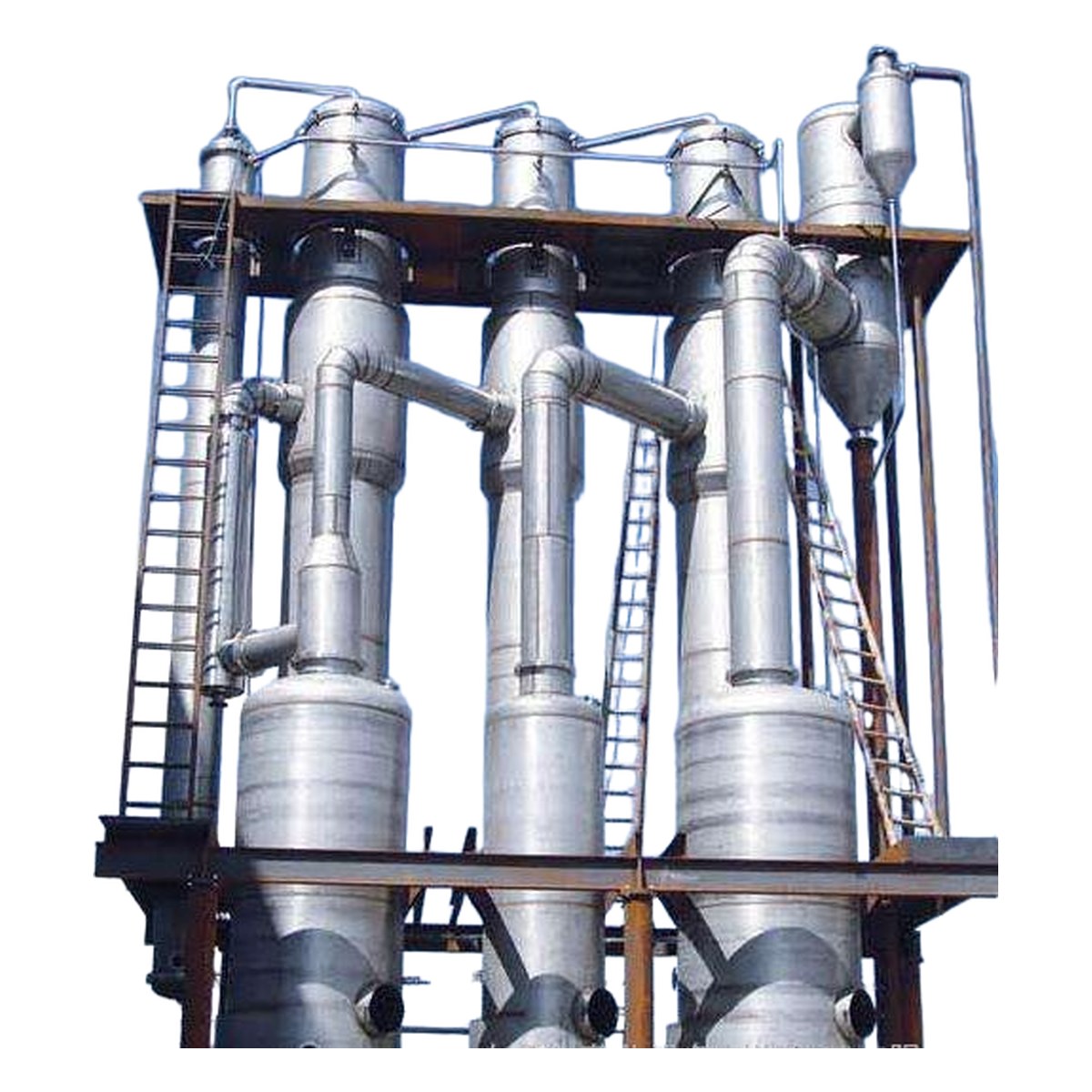
1. Product Overview
Multi-effect evaporators utilize secondary vapor from the previous effect as the heating source for the next effect, significantly reducing live steam consumption. Suitable for large-scale evaporation, high-salinity wastewater treatment, and pre-crystallization concentration.
2. Working Principle
Live steam enters the shell side of the first-effect heater; feed liquid evaporates in the tubes. Secondary vapor then enters the second-effect heater as a heat source, cascading to the final effect. Final-effect vapor is condensed; non-condensables are removed by a vacuum pump. Condensate is recovered stage by stage.
3. System Classification
Table
| Type | Effects | Application |
|---|---|---|
| Double-effect | 2 | Small-to-medium scale, moderate energy-saving |
| Triple-effect | 3 | General-purpose, large-scale concentration |
| Quadruple-to-sextuple-effect | 4~6 | Very large capacity, lowest steam consumption |
4. Detailed Technical Parameters
4.1 Common Materials
Table
| Material | Application | Remarks |
|---|---|---|
| SS 304 / 316L | Product-contact parts | Food, pharma, chemical |
| Carbon steel | Shell, supports | Non-contact parts |
| Titanium / Duplex | Highly corrosive media | Chloride, strong acid |
4.2 Typical Specifications (subject to design)
Table
| Effects | Evaporation Capacity (t/h) | Steam Consumption (kg/kg water) | Typical Feed Concentration |
|---|---|---|---|
| Double | 2 ~ 5 | approx. 0.5 ~ 0.6 | Low |
| Triple | 10 ~ 50 | approx. 0.33 ~ 0.4 | Low-to-medium |
| Quadruple | 50 ~ 150 | approx. 0.25 ~ 0.3 | Medium |
| Quintuple | 100 ~ 200 | approx. 0.2 ~ 0.25 | Medium-to-high |
| Sextuple | 150 ~ 300 | approx. 0.17 ~ 0.2 | Medium |
4.3 Design Conditions & Performance
Table
| Parameter | Specification |
|---|---|
| Final-effect vacuum | 0.015 ~ 0.035 MPa (absolute) |
| Temperature difference per effect | 10 ~ 20 °C |
| Evaporation temperature range | 45 ~ 120 °C (decreasing per effect) |
| Concentration ratio | Customized per material |
5. Electrical Parameters
(Same as MVR evaporator table)
6. Key Component Selection
Table
| Component | Common Brand / Material | Features |
|---|---|---|
| Evaporator heating chamber | SS 304 / 316L / Titanium | Shell-and-tube or plate, ASME VIII-1 design |
| Separator | SS 304 / 316L | Gravity settling + demister |
| Condenser | SS / Carbon steel | Surface or direct-contact type |
| Vacuum pump | Liquid-ring / steam ejector | Maintains final-effect vacuum |
| Circulation pump | Centrifugal / axial-flow | For forced-circulation type |
7. Typical Applications
Chemical: Caustic soda, inorganic salts, dye concentration
Food: Milk, juice, syrup concentration
Pharmaceutical: Extract and fermentation broth concentration
Environmental: High-salinity wastewater, seawater desalination
Salt production: Vacuum salt production, brine evaporation
8. Design Standards & Certifications
Table
| Standard | Description |
|---|---|
| ASME Section VIII Div.1 & 2 | Pressure vessel design and fabrication |
| ASME Section IX | Welding procedures and qualifications |
| NBIC | National Board Inspection Code |
| PED 2014/68/EU | EU Pressure Equipment Directive |
| ISO 9001:2015 | Quality management system |
| CE / EAC / GOST-R | Available upon request |
9. Optional Custom Configurations
Table
| Option | Details |
|---|---|
| Evaporation mode | Falling film / Rising film / Forced circulation |
| Heat exchanger type | Shell-and-tube / Plate |
| Thermo-compressor (TVP) | Boosts low-pressure vapor using high-pressure steam |
| Automatic control | PLC/DCS with online density and level control |
10. Warranty Terms
(Same as MVR evaporator)
11. Packaging and Delivery
Table
| Item | Packaging |
|---|---|
| Evaporator body | Tarpaulin, naked or wooden skid |
| Separator / condenser | Tarpaulin, wooden skid |
| Pumps / valves / instruments | Wooden cases or waterproof packing |
| Container estimate | Triple-effect 50 t/h: approx. 3~4×40'HC; larger units by break bulk |
12. Information Required for Inquiry
12. Information Required for QuotationMaterial name and properties, throughput (t/h), inlet/outlet concentration, viscosity and boiling-point rise, scaling/crystallization tendency, available steam pressure/temperature, power supply, delivery terms, destination port.