Forced Circulation Evaporator
Evaporation
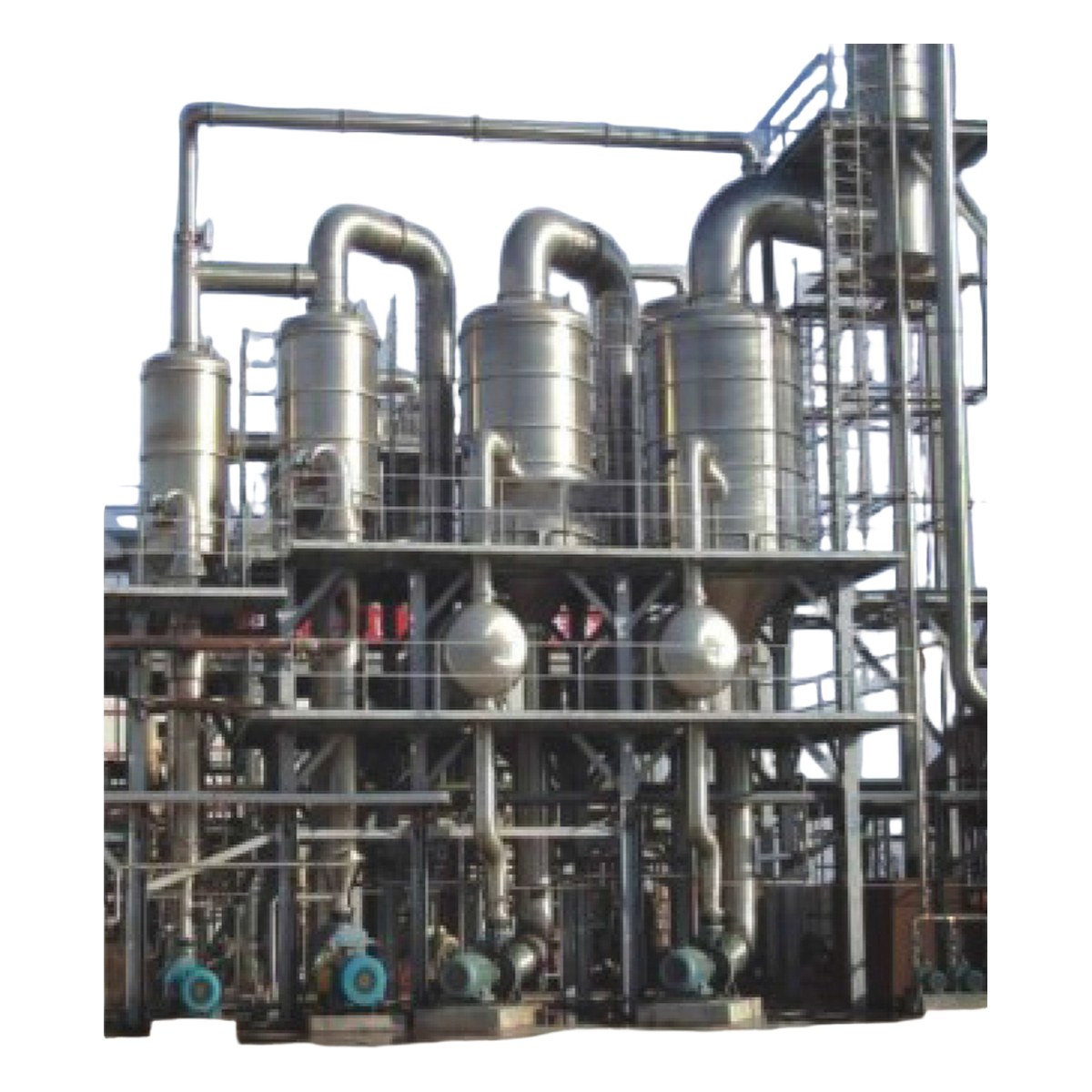
1. Product Overview
The forced circulation evaporator relies on a large-flow circulation pump to force the feed liquid to circulate between the heating chamber and the separation chamber at a velocity of 1.5 ~ 3.5 m/s, preventing scaling, crystallization and blockage of the material on the heating surface. It is suitable for the concentration and evaporative crystallization of high-viscosity, scaling-prone and crystal-precipitating liquids, and is often combined with a thickener, a centrifuge and a mother liquor reflux system into a complete zero liquid discharge (ZLD) plant for high-salinity wastewater.
2. Working Principle
The feed liquid is drawn from the bottom of the evaporation / separation chamber by the forced circulation pump and sent to the shell-and-tube heating chamber (tube side or shell side) to be heated by 2 ~ 5 °C; after entering the separation chamber it is flash evaporated as the pressure drops. The vapor (secondary steam) passes through the demister and goes to the condenser or serves as the heat source of the next effect, while the concentrate (or crystal magma) continues to return to circulation and is discharged continuously (or intermittently) once the target concentration or supersaturation is reached. The high circulation ratio keeps the heating surface constantly flushed by the high-velocity liquid flow, enabling long-term scaling-free continuous operation.
3. System Classification
Forced circulation concentration type: intended for concentration, with a circulation ratio of about 20 ~ 50 times, suitable for high-viscosity, scaling-prone material containing a small amount of solids
Forced circulation evaporative crystallization type: used together with a crystallization separation chamber, a thickener and a centrifuge, with a circulation ratio of up to 100 ~ 150 times, used for evaporative crystallization and salt production
4. Detailed Technical Parameters
4.1 Common Materials of Construction
Table
| Material | Applicable Parts | Remarks |
|---|---|---|
| 316L stainless steel | Parts in contact with the material, heating tubes, circulation piping | General corrosion-resistant material |
| Duplex steel 2205 / 2507 | Parts in contact with high-chloride material | High-salinity wastewater and salt crystallization service |
| Titanium TA2 / nickel-based alloy C-276 | Parts in contact with strongly corrosive material | Acidic salt solution and hypochlorite-containing service |
4.2 Typical Specifications (subject to the actual process design)
Table
| Item | Parameter Range |
|---|---|
| Evaporation capacity | 1,000 ~ 60,000 kg/h (single unit) |
| Circulation ratio | 20 ~ 150 times (concentration type / crystallization type) |
| Velocity inside the heating tubes | 1.5 ~ 3.5 m/s |
| Live steam pressure | 0.3 ~ 0.8 MPa |
| Heating chamber temperature | 90 ~ 150 °C |
| Evaporation temperature | 55 ~ 100 °C (45 ~ 80 °C under vacuum) |
| Heating area | 50 ~ 2,000 m² (as configured for the process) |
| Discharge concentration | Up to 40% ~ 70% for the concentration type; 20% ~ 50% solids content of crystal magma for the crystallization type |
| Installed power | Forced circulation pump 30 ~ 500 kW (as configured for the capacity), continuous operating cycle 30 ~ 90 days |
4.3 Design Conditions and Performance Indicators
Table
| Parameter | Specification |
|---|---|
| Concentration / crystallization capacity | Concentration ratio 2 ~ 8 times; crystal size 0.2 ~ 1.0 mm (adjustable) |
| Steam consumption per 1 t of water evaporated | Approx. 1.1 t for a single effect; ≤ 0.6 t for a double effect; ≤ 0.4 t for a triple effect |
| System vacuum degree | -0.06 ~ -0.095 MPa (determined by the boiling point elevation of the material) |
5. Electrical Parameters
Table
| Applicable Region | Voltage | Frequency |
|---|---|---|
| China / Russia / Central Asia | 380 V | 50 Hz |
| Middle East / Southeast Asia / Africa | 400 V / 415 V | 50 Hz |
| South Korea | 380 V | 60 Hz |
| Americas | 440 V / 480 V | 60 Hz |
6. Selection of Core Components
Table
| Component Name | Common Brand / Material | Features and Application |
|---|---|---|
| Forced circulation pump | Large-flow axial flow pump / centrifugal pump (customized) | Core power component with variable frequency speed control, determines the circulation velocity and circulation ratio |
| Heating chamber | 316L stainless steel, duplex steel, titanium | Large-diameter short tube bundle for easy mechanical cleaning and resistance to scaling |
| Evaporative crystallization separation chamber | 316L stainless steel | Large-volume low-velocity zone favorable for crystal growth and settling |
| Thickener / centrifuge | 316L stainless steel, duplex steel | Thickening of crystal magma and solid-liquid separation (optional) |
| Vacuum and condensing system | Liquid ring pump, dry screw pump, shell-and-tube condenser | Maintains the system vacuum, condenses vapor (secondary steam) and recovers condensate |
7. Typical Application Fields
Chemical: evaporative crystallization of inorganic salts, concentration of caustic soda and soda ash, concentration of dye intermediates
Environmental protection: zero liquid discharge (ZLD) of high-salinity wastewater, evaporative crystallization of landfill leachate
Pharmaceutical: concentration of traditional Chinese medicine extracts and fermentation broth, and pre-crystallization treatment
Food and salt production: vacuum salt production, evaporative crystallization of brine, concentration of sugar solutions
8. Design Standards and Certification
Table
| Standard | Description |
|---|---|
| GB/T 150.1~150.4-2024 Pressure Vessels | Design, manufacture and inspection of pressure vessels |
| GB/T 151-2014 Heat Exchangers | Design code for the heating chamber heat exchanger |
| TSG 21-2016 Safety Technical Supervision Regulation for Stationary Pressure Vessels | Safety technical supervision of pressure-containing equipment |
| NB/T 47013-2015 Nondestructive Testing of Pressure Equipment | Nondestructive testing of welds |
| NB/T 47014-2011 Welding Procedure Qualification for Pressure Equipment | Welding procedure qualification |
| GB/T 5226.1-2019 Electrical Safety of Machinery | Safety requirements for the electrical equipment of machines |
| JB/T 20103-2022 Evaporation Concentrator | General requirements for evaporation concentration plants under pharmaceutical service conditions (applied by reference) |
| ISO 9001:2015 / CE / EAC / GOST-R | Quality management system and international order certification |
9. Customization Options
Table
| Option | Details |
|---|---|
| Material upgrade | Parts in contact with the material available in duplex steel 2205/2507, titanium TA2 and nickel-based alloy C-276 |
| Crystallization coupling | Combined with a thickener, a centrifuge and a mother liquor reflux system for integrated evaporative crystallization |
| MVR/TVR coupling | Adding a mechanical vapor recompression unit to recover vapor (secondary steam), significantly reducing live steam consumption |
| Automatic control system | PLC/DCS control with online density, concentration, level and temperature interlocking plus remote operation and maintenance |
10. Warranty Terms
Table
| Equipment Condition | Warranty Period | Warranty Scope |
|---|---|---|
| New equipment | 12 months | Heating chamber, crystallization separation chamber, forced circulation pump and drive system |
| Refurbished equipment | 6 months | Heating chamber, crystallization separation chamber, forced circulation pump and drive system |
| Idle equipment | 3 months | Main functional components |
11. Packaging and Delivery
Table
| Item | Packaging Method |
|---|---|
| Main equipment (heating chamber / crystallization separation chamber) | Wrapped with rain-proof tarpaulin and fixed on a wooden pallet base |
| Forced circulation pump | Fully enclosed wooden case packaging with shock-absorbing fixing |
| Electrical / instruments / accessories | Packed into wooden cases after waterproof sealed packaging |
| Container capacity estimate | Large-diameter heating chambers are mostly shipped in loose parts for on-site assembly; models of ≤2,000 m² take about 2 ~ 4 40 ft high cube containers |
12. Information Required for Inquiry
12. Information Required for Inquiry Material name and characteristics (viscosity, solids content, solubility curve, heat sensitivity), throughput (kg/h or t/h), feed concentration and target discharge concentration, whether crystallization and a target crystal size are required, available steam pressure and temperature, power supply conditions, whether integration with an existing ZLD system is needed, delivery terms (FOB/CIF/DDP) and destination port.